
What is Student Accident Insurance and Why Do You Need It?
When Accidents Happen at School, Are You Financially Protected?
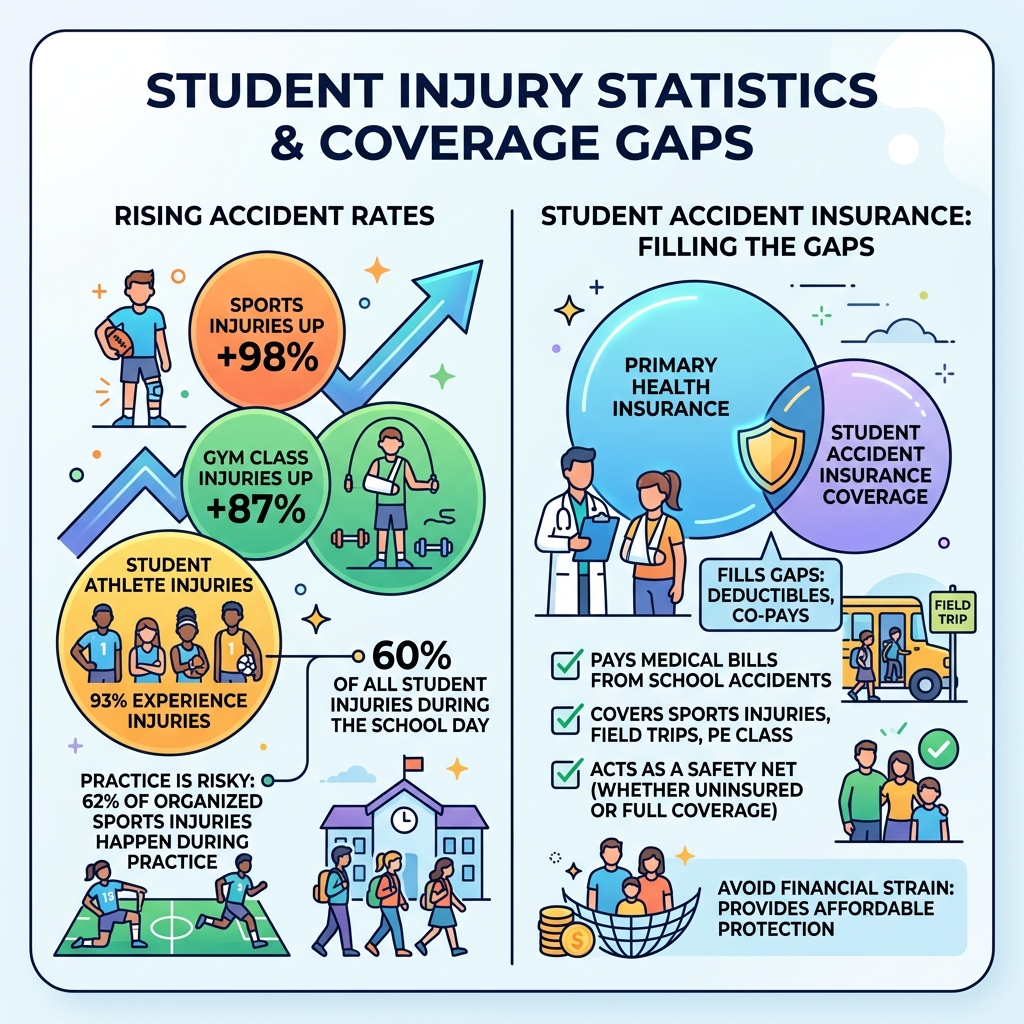
Student accident insurance coverage is a type of supplemental insurance that pays for medical costs when a student is injured during school activities — and it works alongside (not instead of) your regular health insurance.
Here’s a quick breakdown of what it covers and why it matters:
| What It Does | What It Does Not Do |
|---|---|
| Pays medical bills from accidents at school | Cover illness or sickness |
| Covers sports injuries, field trips, and PE class | Replace your primary health insurance |
| Fills gaps like deductibles and co-pays | Cover injuries from non-school activities (unless 24-hour plan) |
| Provides coverage even if student is uninsured | Pay out for pre-existing conditions |
The numbers make a strong case for this kind of protection:
- 93% of student athletes experience some kind of injury during their careers
- 62% of organized sports injuries happen during practice, not just games
- School injury rates have risen sharply — sports injuries up 98%, gym class injuries up 87%
- 60% of all student injuries happen during the regular school day
That’s a lot of risk. And medical bills from even a minor fracture or dental injury can run into the hundreds — or thousands — of dollars.
For budget-conscious students and families, one unexpected accident can seriously strain finances. Student accident insurance is designed to be affordable and act as a safety net, whether your child has full health coverage or none at all.
Student accident insurance coverage vocabulary:
Understanding Student Accident Insurance Coverage

When we talk about student accident insurance coverage, we are looking at a specialized shield designed to protect families from the financial fallout of a “oops” moment. Whether it is a tumble on the playground, a collision during a soccer match, or a slip in the science lab, these policies are built to catch the costs that fall through the cracks of traditional health plans.
For K-12 students, this coverage often follows them through the school day and into school-sponsored extracurriculars. For college students, it serves as a vital layer of protection, especially for those who might be moving away from home. If you are curious about how your standard health plan behaves when you leave the campus bubble, check out our guide on how to use your student health plan when you wander off campus.
In its simplest form, this insurance covers medical expenses, accidental death, and dismemberment (AD&D). It acts as a “gap coverage” tool. If you have a high-deductible health plan, the accident policy can step in to pay that $2,000 or $5,000 deductible if your child breaks an arm during gym class.
Defining student accident insurance coverage vs. Health Insurance
It is important to understand that this is accident-only coverage. If your child wakes up with the flu or needs a routine physical, this policy won’t help. It specifically excludes “sickness.” Think of it as a supplemental tool. While your primary health insurance is the broad umbrella, the accident policy is the sturdy pair of rain boots that protects you specifically from the puddles of unexpected injury costs.
The beauty of this coverage is its supplemental nature. It is designed to handle out-of-pocket costs like co-pays, emergency room fees, and even those expensive “orthopedic appliances” (like crutches or braces) that primary insurance sometimes skimps on.
Eligibility for Voluntary and Mandatory Plans
Who can get in on this? Eligibility is broader than you might think:
- Public and Private K-12 Schools: Most policies cover students from Pre-K through 12th grade.
- Higher Education: College students, including those in community colleges or large universities, are often eligible for semester-based plans.
- School Consortiums: Many schools band together to offer group rates.
- International Students: Special provisions often exist for students studying abroad who need to meet specific visa requirements.
Most plans have an age limit, typically ranging from 6 months up to 27 years old. For those over 14, there is usually a requirement to be enrolled as a full-time student (often defined as taking at least three courses in a four-month period).
Exploring Coverage Options and Benefit Tiers
Not all student lives are the same, so the insurance shouldn’t be either. We generally see three main “shapes” of coverage:
- School-Time Only: This covers the student while they are on school grounds, during school hours, or participating in a school-sponsored event (like an away game or a field trip). It even includes the commute to and from school.
- 24-Hour Protection: This is the “gold standard.” It covers the student 24/7, 365 days a year, whether they are at school, at home, or on summer vacation.
- Extended Dental: A specific add-on for those pearly whites, often providing up to $25,000 in coverage for accidental dental injuries.
| Feature | Voluntary Plan | Blanket/Mandatory Plan |
|---|---|---|
| Who Pays? | Parents/Students | School District/Institution |
| Enrollment | Individual choice | Automatic for all students |
| Cost | Low annual premium | Built into tuition or fees |
| Coverage Scope | Can be 24-hour or School-time | Usually School-sponsored activities |
Sports and Catastrophic Coverage
Sports are where the risks skyrocket. Statistics show that 98% of sports injuries are significant enough to require some level of medical attention. Because of this, many basic plans exclude “interscholastic football” unless you pay an additional premium.
For the most serious incidents, catastrophic coverage is essential. These plans offer massive limits—sometimes up to $7.5 million—with benefit periods that can last up to 104 weeks or even 10 years. This is for the life-altering injuries that require long-term nursing care or home modifications.
Ancillary Benefits and Travel
Accidents aren’t just about broken bones. Comprehensive policies often include:
- Accidental Dental: Covering up to $25,000 for tooth repair.
- Vision/Hardware: Replacement of glasses or contacts broken in an accident.
- Emergency Evacuation: Crucial for students on field trips or studying abroad.
- Critical Illness: Some advanced plans (like those in Canada) even include benefits for rare diseases like poliomyelitis.
During stressful times following an injury, mental health is just as important as physical health. If a student is struggling, the Suicide & Crisis Lifeline is a vital, free resource available 24/7.
How to Evaluate and Purchase a Policy
When we look at whether a policy is “worth it,” we have to look at the math of modern healthcare. With the rise of high-deductible health plans, a “minor” ER visit can easily cost a family $1,500 out of pocket. A student accident insurance coverage plan might only cost $30 to $100 for the entire year.
It also serves as an “uninsured safety net.” For the millions of students without primary health insurance, this plan ensures they can at least get treated for injuries without bankrupting their families. Before you sign on the dotted line, make sure you don’t get schooled by the 5-star student policies—read the fine print on what “usual and customary” charges really mean.
Maximizing Your student accident insurance coverage Benefits
To get the most out of your policy, you need to understand the “Order of Operations.” Most plans are Excess Coverage, meaning they pay after your primary insurance has done its part.
- Primary Basis: The plan pays first, regardless of other insurance.
- Excess Basis: The plan pays the remaining balance (deductibles, co-pays) after your primary health insurance pays.
- Coordination of Benefits: This ensures you aren’t paid twice for the same injury, but it helps reach “first-dollar coverage” where you pay $0 out of pocket.
Where to Buy and Enrollment Steps
Purchasing is usually a breeze. Most schools partner with specific insurance providers to offer these plans.
- Check the School Website: Look for the “Insurance” or “Student Services” tab.
- Online Portals: Most providers have a “Find My School” tool where you enter your state and district.
- Semester-Based Enrollment: For college students, you often buy coverage at the start of each semester via the Cashier’s Office.
- Open Enrollment: While you can often join year-round, it’s best to enroll at the start of the school year to ensure no gaps.
Navigating the Claims Process and Exclusions
Filing a claim shouldn’t be scarier than the accident itself. The most important rule? Don’t wait. Most policies have a 90-day window to both seek treatment and file the initial claim form.
Common Policy Limitations and Exclusions
We want to be realistic: this insurance isn’t a “magic wand” for every medical bill. Standard exclusions include:
- Pre-existing Conditions: Injuries that happened before the policy started.
- Self-inflicted Injuries: Intentional harm is never covered.
- Illness/Sickness: As mentioned, no coverage for the flu, infections, or chronic diseases.
- Criminal Acts: Injuries sustained while committing a felony.
- Non-partnered Schools: You generally can’t buy a voluntary school plan if your district hasn’t officially “enrolled” with that provider.
Coordination of Primary and Excess Coverage
If you have primary insurance, the accident policy acts as the “secondary payer.” It is a champion at deductible reimbursement and covering those pesky co-insurance fees. If your primary insurance denies a benefit because it’s “not covered” (like certain types of physical therapy), the accident plan might still step in to cover it.
To ensure your claim isn’t delayed, you must provide:
- A completed and signed Claim Form (usually signed by a school official to verify the accident happened at school).
- Itemized Bills (called HCFA-1500 or UB-04 forms) from the doctor or hospital.
- The Explanation of Benefits (EOB) from your primary insurance.
Frequently Asked Questions about Student Accident Insurance Coverage
Does this policy cover my child if they get sick at school?
No. Student accident insurance coverage is strictly for injuries resulting from an accident. For things like the flu, stomach bugs, or chronic conditions, you will need to rely on your primary health insurance or a standard student health plan.
Will the insurance cover injuries sustained during away games or field trips?
Yes! As long as the activity is school-sponsored and supervised, coverage typically follows the student. This includes travel in school-provided transportation to and from the event.
Can I use my own family doctor for an accident claim?
In most cases, yes. Many of these plans allow for an “unrestricted choice” of medical providers. However, we always recommend checking if the doctor is “in-network” for your primary insurance first to minimize the total costs that the accident plan will need to pick up.
Conclusion
At ACT Unis, we believe that a student’s focus should be on their grades and their teammates, not on how they will pay for a trip to the ER. Student accident insurance coverage is one of the most cost-effective risk management tools available to modern families. It provides financial peace of mind, ensuring that an afternoon at the playground doesn’t turn into a decade of medical debt.
Whether you are looking for a safety net for a high-deductible plan or need base coverage for an uninsured student, taking this step is a smart move for your child’s safety and your wallet’s health. Protect your student today and breathe a little easier the next time the whistle blows.