
Top Rated Health Insurance Plans for Your Semester Abroad
Why Health Insurance for Study Abroad Can Make or Break Your Semester
Health insurance for study abroad is one of the most important things you need to sort out before you leave — and in many cases, it’s not optional.
Here’s a quick look at the types of plans to compare:
| Plan Tier | Starting Cost | Medical Maximum | Best For |
|---|---|---|---|
| Basic Student Plan | ~$30/month | $400,000 | Budget-conscious F-1/J-1 students |
| Standard Student Plan | ~$50/month | $1,000,000 | Mid-range coverage with high limits |
| Premium Student Plan | ~$75/month | Unlimited | Comprehensive protection |
| Visa-Compliant Plan | From $29/month | $1,000,000 | Visa compliance + school requirements |
| Specialized OPT Plan | Varies | Unlimited | Pre-existing conditions, OPT students |
| Global Education Plan | Varies | Unlimited | Schengen + J-1/F-1 compliance |
Studying in another country is exciting. But one unexpected illness or injury abroad can cost you thousands of dollars out of pocket — sometimes tens of thousands.
Most home-country health plans don’t cover international care. And in countries like the U.S. or Switzerland, where healthcare is privatized, a single hospital visit without insurance can wipe out your entire semester budget.
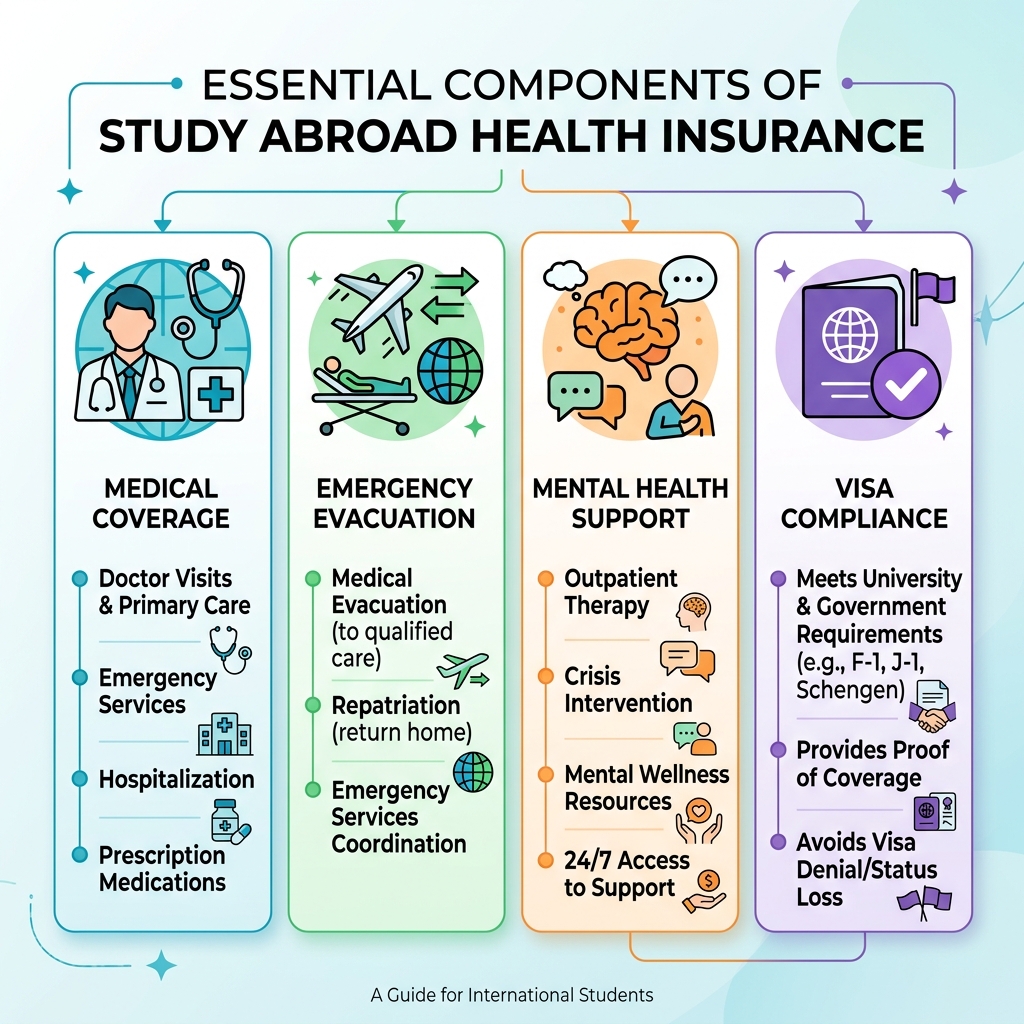
Beyond the financial risk, many student visas — including the F-1 and J-1 in the U.S. — and most universities require proof of health insurance before you even step on campus. Without the right plan, you could lose your visa status or be blocked from enrolling.
The good news? There are solid, affordable plans built specifically for students. Some start at under $30 a month and cover everything from doctor visits and emergency evacuation to mental health support and telehealth.
This guide compares the best options so you can find the right fit for your visa type, destination, budget, and health needs.
Essential Requirements for health insurance for study abroad
Navigating the legalities of international education can feel like trying to solve a Rubik’s cube in the dark. However, understanding the baseline requirements for health insurance for study abroad is the first step to securing your spot in a foreign lecture hall.

For those heading to the United States, the visa type dictates the rules. F-1 visa holders (academic students) are usually subject to their university’s specific insurance mandates. J-1 visa holders (exchange visitors), however, must meet strict federal requirements set by the U.S. Department of State. These include:
- Medical benefits of at least $100,000 per accident or illness.
- Repatriation of remains coverage of at least $25,000.
- Medical evacuation coverage to the home country of at least $50,000.
- A deductible that does not exceed $500 per accident or illness.
If you are heading to Europe, specifically the Schengen Area, you must provide proof of insurance to obtain a visa. These plans must cover all 26 Schengen countries with a minimum medical limit of €30,000.
It is also vital to keep an eye on the Level 4 Travel Advisory list. Many insurance providers will not cover trips to countries with high-risk conflict or safety warnings. Always check that your destination isn’t on the “do not travel” list before purchasing your policy, as this could void your coverage.
Choosing the Best health insurance for study abroad Plans
When we look for the “best” plan, we aren’t just looking at the cheapest monthly premium. We look at the “Medical Maximum”—the total amount the insurer will pay for your care. While budget plans might cap out at $100,000, premium plans offer unlimited or multi-million dollar maximums.
For a deep dive into the nuances of these policies, check out The Ultimate Guide to Insurance for Students Studying Overseas.
Key features to prioritize include:
- Inpatient Care: Coverage for hospital stays, surgeries, and intensive care.
- Outpatient Services: Visits to a local GP for a sinus infection or a quick check-up.
- Provider Networks: Large networks mean you can find a doctor who accepts your insurance directly, avoiding “pay and claim” hassles.
- 24/7 Assistance: Access to a multilingual support line is a lifesaver when you’re trying to find a pharmacy in a city where you don’t speak the language.
How to Waive University health insurance for study abroad
Most universities will automatically enroll you in their own “school-sponsored” health plan. These are often convenient but can be significantly more expensive than private options. If you want to save money, you can apply for a “waiver.”
To do this, you must prove that your private health insurance for study abroad provides comparable coverage. This usually means your plan must meet or exceed the university’s specific limits for deductibles and medical maximums.
Steps to a successful waiver:
- Download the Waiver Form: Get this from your school’s international student office early.
- Review the U.S Prescription Drug List: Ensure your private plan covers medications at a level the school deems acceptable. You can find standard lists for comparison.
- Submit Proof of Enrollment: You’ll need your visa or acceptance letter to finalize your private purchase.
- Present your Insurance ID Card: Once enrolled, you’ll receive a digital or physical card. Submit a copy of this along with your policy summary to the school.
Be mindful of deadlines! Missing a waiver deadline by even one day can result in a non-refundable charge of $2,000 or more on your tuition bill.
Key Coverage Benefits for International Students
What exactly are you paying for? Beyond just “doctor visits,” specialized student plans include “safety net” benefits that standard domestic plans lack.
Medical Evacuation and Repatriation If you have a serious accident in a remote area or a country without adequate medical facilities, medical evacuation covers the cost of transporting you—often via air ambulance—to the nearest high-quality hospital. This can cost over $100,000 out of pocket. Repatriation of remains ensures that in the tragic event of a death, the costs of returning the student to their home country are covered.
Mental Health Support Studying abroad is stressful. Culture shock, academic pressure, and being away from family can take a toll. Modern plans now prioritize mental health, offering counseling sessions and 24/7 crisis support. This is a critical component of How to Use Your Student Health Plan When You Wander Off-Campus safely.
Sports and Adventure Coverage Are you planning on joining an intramural soccer team or going scuba diving on spring break? Many basic plans exclude “hazardous activities.” If you’re active, look for a plan that covers organized sports, or add-ons for adventure activities.
Telehealth and Prescriptions In the age of digital health, many students prefer a “virtual visit.” Telehealth allows you to speak with a doctor from your dorm room, which is perfect for minor illnesses or getting a prescription refill without navigating a foreign hospital system.
Comparing Costs and Plan Structures
Pricing for health insurance for study abroad is influenced by your age, destination (the U.S. is the most expensive), and the level of coverage you choose.
| Feature | Short-Term Travel Medical | Long-Term Global Student Health |
|---|---|---|
| Duration | 5 days to 12 months | 1 year to 5 years (renewable) |
| Best For | Summer programs / Gap years | Full degree programs / OPT |
| Deductibles | $0 – $2,500 | $0 – $5,000 |
| Pre-existing Conditions | Usually excluded | Covered after waiting period (or waived) |
| Maternity | Rarely covered | Often included in “Platinum” tiers |
For students on OPT (Optional Practical Training) or STEM OPT, maintaining coverage is vital. Comprehensive global plans allow you to extend your student coverage while you are gaining work experience post-graduation. If you are traveling with a spouse or children, look for “Dependent Options,” as many university plans make it difficult or prohibitively expensive to add family members.
Frequently Asked Questions about Student Coverage
Does student insurance cover pre-existing conditions?
Yes, but it depends on the plan. Some “lite” plans exclude them entirely. However, premium plans may cover pre-existing conditions immediately if you can provide proof of “creditable coverage” (meaning you were insured under another plan for the 6 months prior). Others may have a “waiting period” of 6 to 12 months before coverage kicks in.
Can I keep my health insurance during OPT or STEM OPT?
Absolutely. Most major providers have specific provisions for students on OPT. As long as you maintain your F-1 visa status and are actively participating in the OPT program, you can usually renew your policy for the duration of your stay.
What is the difference between travel insurance and international health insurance?
This is a common point of confusion.
- Travel Insurance is designed for short trips. It focuses on trip cancellations, lost luggage, and emergency medical care. It is usually “secondary” to your primary health insurance.
- International Health Insurance is “primary” coverage. It is designed for people living abroad for long periods. It covers routine care, prescriptions, mental health, and long-term illnesses, acting much like the health insurance you have at home.
Conclusion
Preparing for a semester abroad is a whirlwind of visa interviews, flight bookings, and packing lists. But among all the excitement, don’t let your health fall through the cracks. At ACT Unis, we believe that global safety is the foundation of a successful education.
Choosing the right health insurance for study abroad isn’t just about checking a box for your visa; it’s about ensuring that if the worst happens, you have a team of professionals ready to help you get back into the classroom. Whether you need a budget-friendly plan for a summer in Spain or comprehensive coverage for a four-year degree in the U.S., there is a plan out there tailored to your journey.
Stay safe, study smart, and embrace the adventure. For more info about student insurance, visit our resource center and start your semester with total peace of mind.