
The Nerd’s Guide to Cheaper Car Insurance
Why Good Students Pay Less for Car Insurance (And How to Get That Discount)
Good student discount car insurance is a real, widely available way for young drivers to cut their premiums — often by 10% to 25% — just by keeping their grades up.
Here’s the quick version of what you need to know:
| What You Need | Details |
|---|---|
| Minimum GPA | 3.0 (B average) or top 20% of class |
| Age range | Typically 16-25 |
| Enrollment status | Full-time student (high school or college) |
| Proof required | Report card, transcript, or honor roll certificate |
| Annual savings | Roughly $148 to $780 per year |
| Best discount available | Up to 25% off (varies by insurer) |
Insuring a young driver is expensive. Premiums for teen and college-age drivers can run $2,800 to $4,500 per year — before any discounts.
That stings when you’re already stretched thin on textbooks, rent, and groceries.
The good news? Your grades are worth real money. A student with a B average or better can qualify for a good student discount that saves hundreds of dollars a year — with surprisingly little effort to claim it.
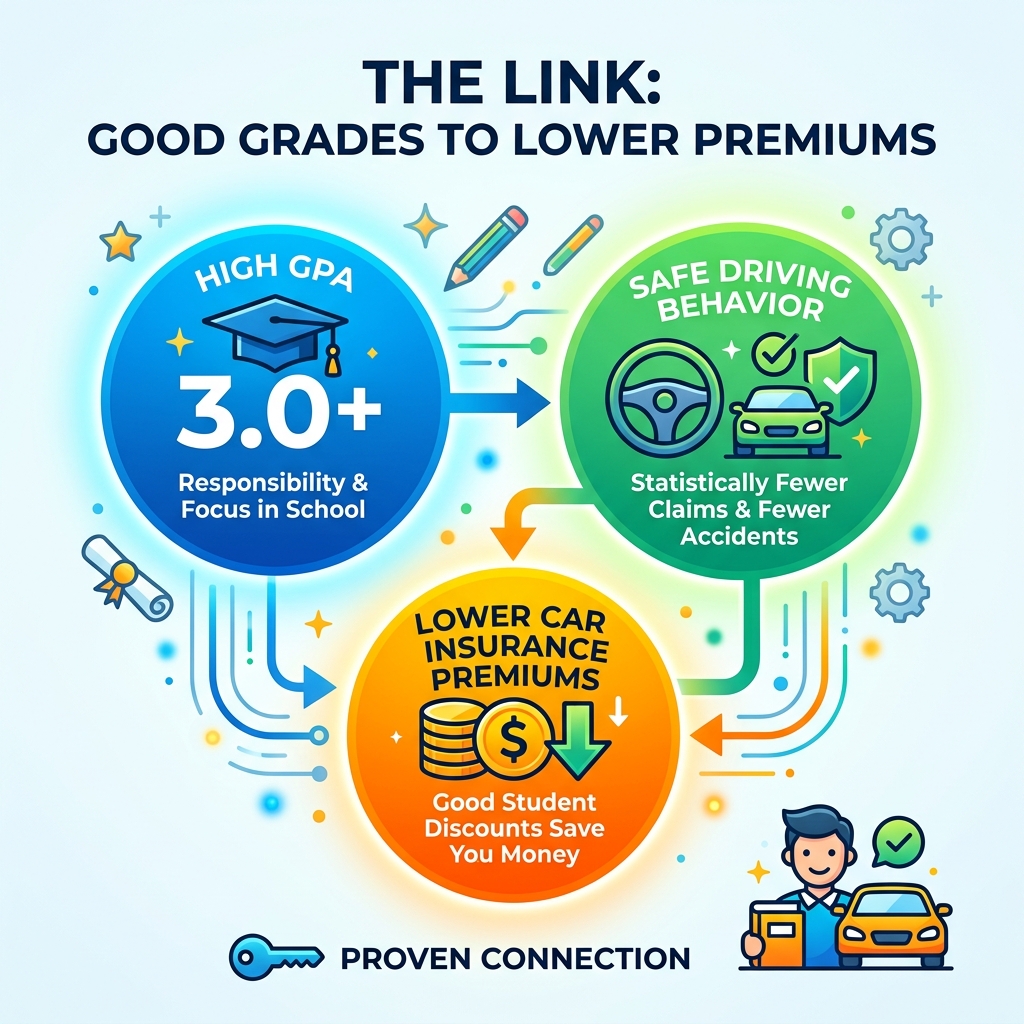
Insurers aren’t just being generous here. Their data shows that students who perform well academically tend to file fewer claims. Better grades signal responsibility, focus, and lower risk behind the wheel. So they reward it.
This guide breaks down exactly how to qualify, what documents you need, which insurers offer the biggest discounts, and how to stack multiple savings together for maximum impact.
Understanding the Good Student Discount Car Insurance Benefit
To understand why good student discount car insurance exists, we have to look at the “boring” side of insurance: actuarial logic. Insurance companies are essentially professional gamblers. They bet on how likely you are to get into an accident. When it comes to young drivers, the odds aren’t usually in the driver’s favor. Statistically, drivers aged 16 to 25 are involved in more accidents due to inexperience and higher risk-taking behaviors.
However, decades of data have revealed a fascinating trend: students who excel in the classroom are statistically safer on the road. This isn’t just a hunch; it is backed by scientific research on teen driving safety. High academic performance often correlates with qualities like responsibility, time management, and a greater awareness of consequences. If you are responsible enough to turn in your term paper on time and study for a mid-term, insurers believe you are responsible enough to follow the speed limit and avoid distractions while driving.
By offering a premium reduction for good grades, insurance companies aren’t just rewarding “nerds”—they are identifying a lower-risk subgroup within a high-risk age bracket. This leads to Student car insurance that costs less than your textbooks! and helps families manage the sky-high costs of adding a teen to a policy.
Eligibility Requirements for Academic Savings

While every insurance provider has its own fine print, the general roadmap to qualifying for a good student discount car insurance benefit is fairly consistent across the industry. We want to make sure you don’t miss out on these savings because of a technicality.
The primary pillars of eligibility include:
- Full-Time Enrollment: You generally must be enrolled as a full-time student in a high school, college, university, or vocational school. Part-time students typically do not qualify for this specific discount.
- Age Limits: Most programs apply to drivers between the ages of 16 and 25. Once you hit 26, you’re usually considered a “mature” driver in the eyes of the insurance company, and your rates may drop naturally, but the student-specific discount will expire.
- GPA Thresholds: The “magic number” is almost always a 3.0 GPA.
- Class Ranking: If your school doesn’t use a traditional GPA scale, being in the upper 20% of your class is the standard alternative.
It’s important to Don’t get schooled by the 5-star student policies and verify these details with us directly, as some regional variations may apply.
Qualifying with a 3.0 GPA for Good Student Discount Car Insurance
Maintaining a “B” average is the most common way to unlock these savings. On a standard 4.0 scale, this translates to a 3.0 GPA. When we talk about transcript verification, we are looking for cumulative performance or the most recent semester’s results, depending on the specific policy rules.
Other ways to prove you’ve reached this level of academic achievement include:
- Making the Dean’s List or Honor Roll.
- Being a member of a national honor society (like Phi Theta Kappa or the National Honor Society).
- In some cases, scoring in the top 20% on standardized tests if a GPA isn’t available.
Alternative Proofs for Homeschooled Students
We know that not every “good student” sits in a traditional classroom. If you are homeschooled, you are absolutely eligible for good student discount car insurance! Since you might not have a traditional report card issued by a school district, insurers accept alternative forms of proof.
Commonly accepted documentation for homeschoolers includes:
- Standardized Test Results: Scoring in the top 20% of the national norms on the PSAT, SAT, or ACT.
- State Certification: A certification signed by a parent and a representative of the state Department of Education.
- Accredited Curriculum Certificates: Evidence of completing work through an accredited homeschooling program.
In addition to grades, we always recommend looking into Graduated licensing laws in your area, as these systems are designed to help young drivers gain experience safely, which further reduces risk and can lead to even better long-term rates.
How to Apply and Prove Your Performance
Applying for the discount is usually as simple as sending a quick email or uploading a file to an app. You don’t need to wait for your policy renewal to ask for it; if you just got a great report card, you can often apply the discount mid-term to start saving immediately.
The verification frequency varies, but most companies require you to “re-prove” your smarts once a year or every six months (at the start of a new policy term). If your grades slip below a B average, you might lose the discount temporarily, but you can usually get it back once your GPA climbs again.
For those moving away for university, it’s also worth checking out The ultimate guide to insurance for students studying overseas if your academic journey takes you across borders.
Documentation Needed for Good Student Discount Car Insurance
To make the process as smooth as possible, have these documents ready in digital format:
- Grade Cards/Report Cards: The most recent official document from your school.
- Transcripts: An official or unofficial transcript showing your cumulative GPA.
- Honor Roll Certificates: Proof of being named to an academic honors list.
- School Letters: A letter signed by a school administrator or registrar confirming your full-time status and GPA.
- Standardized Test Results: Specifically for homeschooled students or those in schools without traditional grading.
Maximizing Savings: Stacking Your Good Student Discount Car Insurance
The real secret to “nerding out” on insurance is stacking. A good student discount is great, but combining it with other available discounts can cut a premium nearly in half.
Here is a look at how these discounts typically compare and how they can be layered:
| Discount Type | Typical Savings | Who Qualifies? |
|---|---|---|
| Good Student | 10% – 25% | B average, full-time students aged 16-25. |
| Distant Student | 15% – 30% | Students at school 100+ miles from home without a car. |
| Driver Training | 5% – 15% | Completion of an approved driver education course. |
| Telematics | 10% – 30% | Drivers who use an app to track safe driving habits. |
| Multi-Car | 10% – 25% | Families with more than one vehicle on the same policy. |
For example, a college freshman with a $3,000 base premium could save $450 with a 15% good student discount car insurance benefit. If they also attend school more than 100 miles away and leave their car at home, they could stack a “Distant Student” discount, potentially saving over $1,000 in total.
To explore more ways to save, visit our More info about student insurance categories page.
Frequently Asked Questions about Student Discounts
How much money can families save annually?
Families typically save between $148 and $780 per year. For a high school sophomore (age 16) with a high base premium of $4,500, a 20% discount can result in a massive $900 annual saving. For a college student with a $2,800 premium, a 15% discount saves $420. The exact amount depends on your location, the vehicle you drive, and your chosen coverage limits.
Can the discount be combined with safe driver programs?
Yes! In fact, we encourage it. Most insurers allow you to combine academic discounts with “Safe Driver” or “Good Driver” programs (usually requiring no accidents or tickets for 3–5 years). You can also often add discounts for completing a defensive driving course or using telematics programs that monitor your actual driving behavior.
How often must eligibility be verified or renewed?
Typically, you must provide proof of grades once a year. Some insurers may ask for it every six months when your policy renews. It is a good habit to send over your latest transcript as soon as the spring and fall semesters end to ensure your discount never lapses.
Conclusion
At ACT Unis, we believe that hard work in the classroom should pay off in more ways than just a degree. Securing a good student discount car insurance benefit is one of the most effective ways for young drivers and their parents to take control of their financial future while encouraging safe driving habits.
By maintaining that 3.0 GPA, staying enrolled full-time, and keeping your documentation organized, you can transform your academic success into significant long-term savings. Don’t let high premiums school you—use your grades to drive those costs down.
Ready to see how much your GPA can save you? Get a quote today and let us help you find the best path to affordable coverage.