
The Ultimate Guide to Solo Student Travel Insurance
Why a Solo Backpacker Student Policy Is the Safety Net You Can’t Afford to Skip
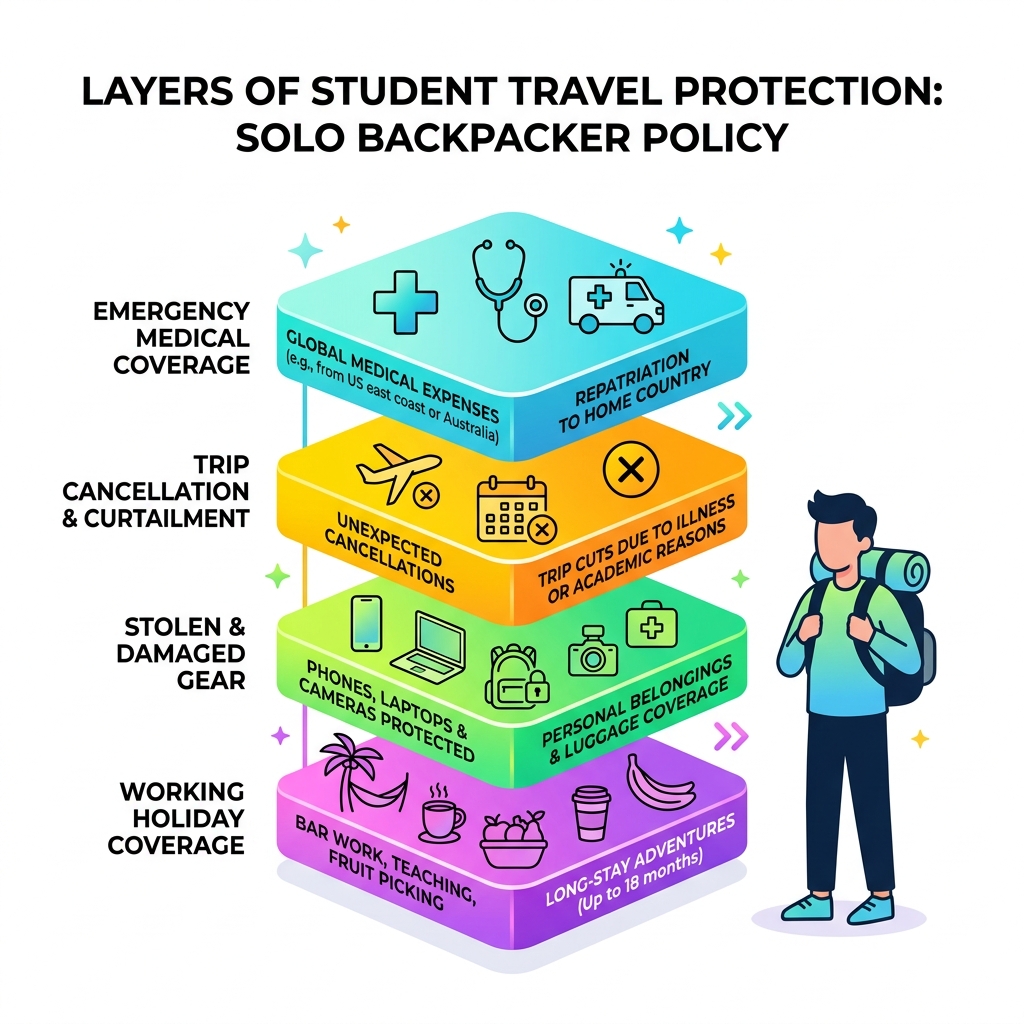
A solo backpacker student policy is the specialized travel insurance designed to protect students who travel independently — covering everything from emergency medical costs to trip cancellations, stolen gear, and even working holidays abroad.
If you’re comparing your options fast, here’s what to look for:
| Feature | What to Check |
|---|---|
| Medical cover | At least £5M–£10M, including repatriation |
| Trip duration | Up to 18 months for long-stay backpacking |
| Activities covered | 100+ sports and activities as standard |
| Working holiday | Bar work, teaching, fruit picking (not heavy manual labor) |
| Return trips home | At least 2 trips, up to 21 days each, without losing cover |
| Gadget protection | Separate or add-on cover for phones and laptops |
| Pre-existing conditions | Declare all conditions before departure |
| Extensions | Option to extend while already abroad |
Here’s a number that puts things in perspective: an air ambulance from the US east coast alone can cost up to £45,000. A medical evacuation from Australia — stretcher, doctor escort, scheduled flight — can run close to £20,000. Without insurance, that bill lands entirely on you.
Students are in a unique position. You’re young, mobile, and ready to explore — but you’re also working with a tight budget and real academic commitments back home. That tension makes choosing the right policy more important, not less.
Whether you’re planning a weekend solo trip during study abroad, a six-month backpacking adventure after graduation, or a university-approved research trip overseas, the rules and risks are different from standard travel. You need coverage built around your situation.
This guide breaks down exactly how to compare specialized student travel insurance — from university business travel requirements to long-stay backpacker policies — so you can travel smarter without draining your savings on the unexpected.
Understanding the Solo Backpacker Student Policy for University Business
When you’re traveling for “university business”—which includes research, conferences, or sanctioned volunteer work—you aren’t just a tourist; you’re an ambassador for your institution. This means there are specific administrative hoops to jump through before you even pack your bag.

The Preauthorization Process
Most universities require students to be registered as “university volunteers” before they are eligible to travel on official business. This isn’t just paperwork for the sake of it; it’s a legal requirement that ensures you are covered by the institution’s liability umbrella.
Before booking your flight, you must complete a Preauthorization Form. This usually requires signatures from a Department Head or an approving official. If you’re heading abroad, you’ll also need the green light from your university’s International Center. They will review official travel advisories and safety records to ensure you aren’t heading into a high-risk zone.
Risk Acknowledgment and Health Plans
A crucial part of the solo backpacker student policy for university travel is the Risk Acknowledgment form. By signing this, you confirm you understand the potential hazards of your destination. Furthermore, you need to know how to use your student health plan off-campus or overseas, as your standard campus clinic won’t be much help when you’re in the middle of the Andes.
Solo vs. Faculty-Led Travel
Traveling solo on university business is a different beast than going with a group led by a professor. When you’re with faculty, they often handle the logistics and direct payments. When you’re solo, you are often responsible for your own bookings, following strict hotel maximums (like the common $333 per night limit for domestic out-of-state travel) and keeping every single itemized receipt for reimbursement.
Essential Coverage in a Solo Backpacker Student Policy
What should a solid solo backpacker student policy actually include? Whether you are on university business or a personal gap year, these elements are non-negotiable.
- Medical Repatriation: This is the big one. If you get seriously ill, this cover pays to fly you back home with medical supervision.
- Academic Protection: Let’s be honest—school doesn’t stop just because you’re in Thailand. If you’re traveling while still enrolled, you might find yourself using Papersowl for managing academic deadlines to keep your grades up. A good policy might even cover tuition fees if a medical emergency forces you to withdraw from a semester.
- Personal Liability: If you accidentally break something in a hostel or cause an accident, this protects you from being sued for thousands.
- Gadget Protection: Your laptop and smartphone are your lifelines. Ensure your policy covers theft or accidental damage, as standard policies often have very low limits for “valuables.”
- Policy Extensions: Plans change! Look for a policy that allows you to extend your cover while you’re already abroad. Many specialist policies allow for a total duration of up to 18 months.
For more details on avoiding common pitfalls, don’t get schooled by 5-star student policies that look good on paper but have high excesses or hidden exclusions.
Navigating Risks with a Solo Backpacker Student Policy
Safety isn’t just about insurance; it’s about preparation. Many universities mandate Driver Safety Training if you plan to use a rental car or personal vehicle for university business.
- Risk Management: Always have a digital and physical copy of your emergency contacts.
- Local Laws: In some countries, even minor infractions can lead to major legal trouble. Research the local customs before you arrive.
- Theft Prevention: Use lockers in hostels and always carry a high-quality padlock. Never leave your gear unattended, even for a “quick” bathroom break at a train station.
Check out the ultimate guide to insurance for students studying overseas for a deep dive into risk mitigation. Also, keep the UK government advice on foreign travel insurance bookmarked; it’s a goldmine for understanding the real-world costs of traveling without a safety net.
Comparing Specialized Student Travel Insurance Features
When you’re shopping for a solo backpacker student policy, you’ll notice that “standard” travel insurance often falls short. Students need longer durations, higher activity limits, and flexibility.
| Feature | Budget Policy | Premium Student Policy |
|---|---|---|
| Max Duration | 31–90 days | Up to 18 months |
| Medical Limit | £1M – £2M | £10M – £15M |
| Return Trips Home | Usually zero | 2 trips (up to 21 days each) |
| Sports/Activities | Low-risk only | 100+ (including bungee, rafting) |
| Working Cover | None | Bar work, fruit picking, teaching |
Long-Stay and Extensions
Most backpackers don’t know exactly when they’ll be back. A dedicated student long-stay policy is designed for trips lasting between 1 and 18 months. One of the best features to look for is the “Return Home” clause. This allows you to fly back for a sibling’s wedding or a holiday break for up to 21 days without canceling your insurance coverage.
Activity Packs and Working Holidays
Are you planning on working in a hostel or picking grapes in France? Standard insurance often excludes any form of “work.” Specialist student policies include “Working Holiday” cover. Just be careful: this usually excludes manual labor involving lifting over 25kg, working at heights over 6m, or using power tools.
If you’re an adrenaline junkie, check the “Activity Packs.” While 100+ sports are usually covered as standard, high-risk activities like skydiving or scuba diving might require an additional premium.
Understanding these nuances is how to not go broke studying abroad when an unexpected injury or lost bag occurs.
Planning Your Journey: Budgeting and Safety for Solo Students
Solo travel is the ultimate crash course in adulting. You are the CEO, the navigator, and the accountant of your trip.
Essential Budget Tools
You don’t need a massive inheritance to see the world, but you do need a plan.
- Rome2Rio for estimating transport costs: This tool is a lifesaver for figuring out if it’s cheaper to take the bus, train, or a budget flight between cities.
- Budget Your Trip for destination planning: This gives you real-world daily costs for food and lodging based on other travelers’ experiences.
- ISIC Card: The International Student Identity Card is recognized in over 130 countries and unlocks thousands of discounts on everything from the Louvre in Paris to bus passes in Vietnam.
Hostel Safety for Solo Backpackers
Hostels are the heartbeat of the backpacking world. They are affordable, social, and often very safe, but you need to be smart:
- Female-Only Dorms: If you’re a solo female traveler, these can provide an extra layer of comfort.
- Read Reviews: Look for mentions of “security” and “lockers” on sites like Hostelworld or Booking.com.
- The “Vibe” Check: Some hostels are “party hostels,” while others are geared toward digital nomads. Choose the one that matches your energy.
Logistics and Connectivity
Don’t rely on finding free Wi-Fi in a crisis. Use eSIMs to ensure you have data the moment you land. Also, make sure you have your visa situation sorted. Websites like iVisa for student visa requirements provide up-to-date info on entry rules, which can change overnight.
If you’re planning a road trip, student car insurance tips can save you a fortune. Often, the insurance offered at the rental counter is a rip-off; your travel policy or a specialized third-party provider might offer better value.
Frequently Asked Questions about Student Solo Travel
What are the per diem rates and receipt requirements for student travel?
When traveling on university business, you are often reimbursed via “per diem”—a daily allowance for meals and incidentals.
- Domestic Per Diem: Typically ranges from $68 to $92 depending on the city’s cost of living. Usually, you don’t need receipts for meals if you stay within this rate.
- International Per Diem: Varies wildly by country.
- Receipts: You always need itemized receipts for lodging, airfare, and rental cars.
- Mileage: For 2024, the standard mileage rate is approximately $0.70 per mile if you use your own car for university business.
When booking your own stays, we recommend using Booking.com for student-friendly stays because they often offer flexible cancellation—essential for students whose schedules might change.
Can I add personal travel days or bring family on a university trip?
Yes, but you have to be meticulous with the accounting.
- Cost Separation: You must document the cost of a “business-only” flight versus the flight with your personal extension. You are responsible for the price difference.
- Liability: The university’s insurance will not cover you during your personal days. This is where your own solo backpacker student policy becomes vital.
- Family: You can usually bring family members, but they must sign liability waivers, and the university will not reimburse any of their costs.
Always double-check how to use your student health plan abroad during those personal days to ensure there are no gaps in your medical coverage.
What are the best affordable destinations and programs for solo students?
If you’re looking for the best “bang for your buck,” consider these student favorites:
- Thailand: Incredible food, cheap hostels ($5–$10), and a well-trodden backpacker trail that makes it easy to meet people.
- Portugal: One of the most affordable countries in Western Europe with a vibrant student culture.
- Japan: While not “cheap,” it is incredibly safe and offers unique experiences like capsule hotels.
If you want more structure than just backpacking, look into:
- IES Abroad programs: Great for earning credits while exploring.
- WWOOF organic farming: Work on a farm in exchange for food and a bed.
- Workaway exchanges: Help out at a hostel or with a family for a few hours a day in exchange for lodging.
- Peace Corps for graduates: A long-term commitment for those looking to make a serious impact post-graduation.
Conclusion
At ACT Unis, we believe that solo travel is the most profound education a student can receive. It builds self-reliance, fosters global empathy, and creates memories that no classroom can replicate. However, the “solo” part of solo travel means you are your own first responder.
By securing a comprehensive solo backpacker student policy, you aren’t just buying insurance; you’re buying the freedom to say “yes” to adventure without the “what if” holding you back. From the bustling night markets of Bangkok to the quiet libraries of Oxford, make sure you’re protected every step of the way.
Ready to gear up for your next trip? Explore more student insurance resources to find the perfect fit for your budget and your dreams. Safe travels!