
How to Handle Disasters and Deferrals While Studying Abroad
Why Every Student Traveler Needs to Understand Their Anxiety Disorder Travel Policy
Anxiety disorder travel policy coverage is something millions of students need but rarely think about until it’s too late.
Here’s a quick answer if you’re short on time:
What does an anxiety disorder travel policy typically cover?
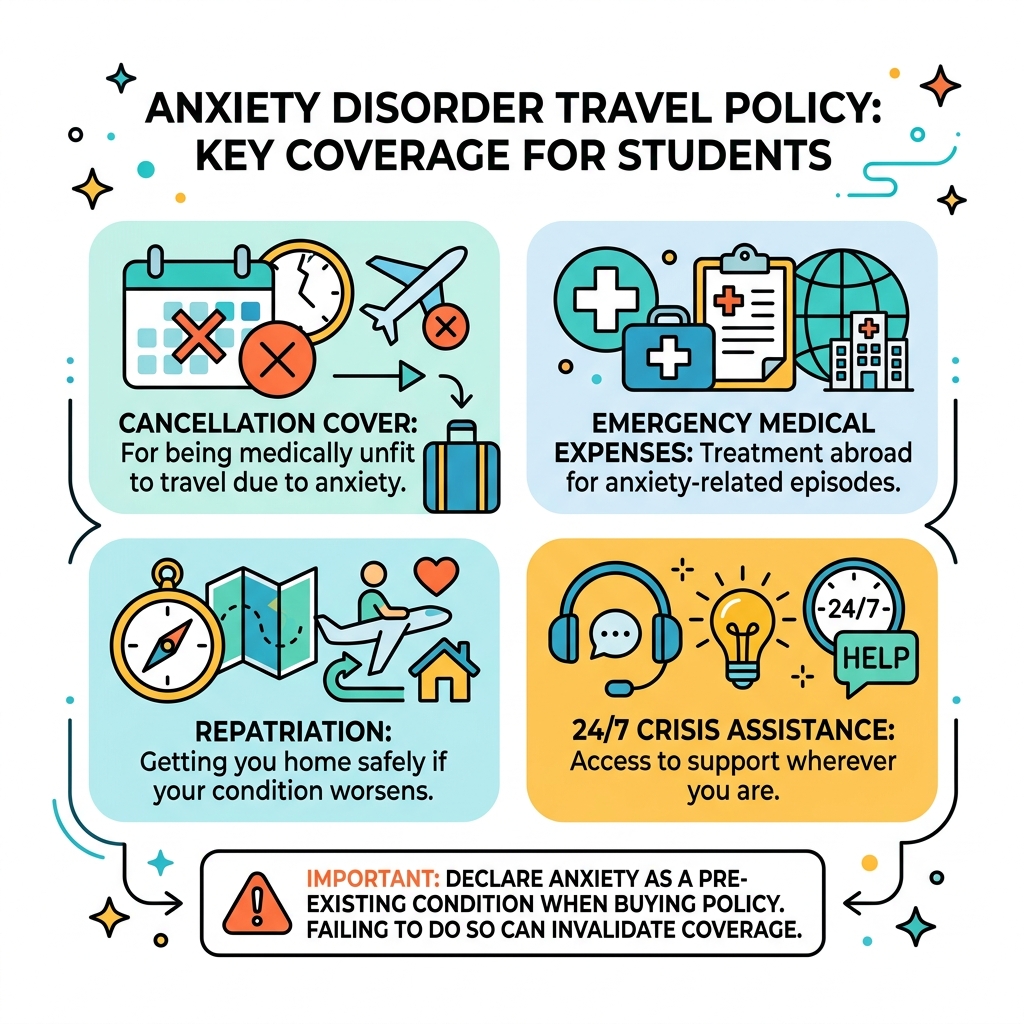
- Cancellation cover – if your anxiety makes you medically unfit to travel
- Emergency medical expenses – treatment abroad for anxiety-related episodes
- Repatriation – getting you home safely if your condition worsens
- 24/7 crisis assistance – access to support wherever you are
Important: You must declare anxiety as a pre-existing condition when buying travel insurance. Failing to do so can invalidate your entire policy.
Anxiety disorders are the most common mental illness in the United States, affecting around 40 million adults every year. In the UK, roughly 1 in 6 people experience a mental health problem. For student travelers, that number hits close to home.
Studying abroad already comes with a full plate – new environments, language barriers, unfamiliar routines, and academic pressure. Add an anxiety disorder into the mix, and even getting to the airport can feel overwhelming.
The good news? The right travel policy can protect you financially and give you the confidence to go anyway.
But most standard travel insurance policies don’t automatically cover mental health conditions. Specialist coverage exists – and knowing how to find it, declare it correctly, and use it when things go wrong is exactly what this guide is for.
Understanding Your Anxiety Disorder Travel Policy and Coverage

When we talk about an anxiety disorder travel policy, we are looking at a specialized type of insurance designed to account for the unique risks associated with mental health. Standard policies often have a “mental health exclusion” buried in the fine print. This means if you have a panic attack and miss your flight, or need to see a doctor abroad for an anxiety flare-up, a basic policy might leave you footing the entire bill.
Pre-existing Conditions and the “Honesty Policy”
In the insurance world, anxiety is considered a “pre-existing condition.” This applies if you have ever been diagnosed, received treatment, or even just spoken to a doctor about your symptoms. We cannot stress this enough: you must declare it.
Some students worry that declaring anxiety will make their insurance unaffordable. While it can influence the premium, for many with stable, well-managed conditions, the increase is often minimal. The risk of not declaring is much higher—your entire policy could be voided, meaning even a claim for a stolen phone or a broken leg could be rejected because you weren’t “forthcoming” about your medical history.
The Medical Screening Process
When applying for an anxiety disorder travel policy, you’ll likely go through a medical screening. Don’t worry; it’s not an interrogation! It usually involves a few simple questions:
- Have you been hospitalized for your condition in the last two years?
- Are you currently taking medication?
- Have you had any changes to your treatment plan recently?
If your anxiety is well-managed, you can often get an instant quote online. For more complex histories, you might need to chat with a specialist who understands mental health nuances.
Standard vs. Specialist Coverage
| Feature | Standard Travel Insurance | Specialist Anxiety Policy |
|---|---|---|
| Mental Health Coverage | Often excluded or very limited | Explicitly included |
| Cancellation for Anxiety | Rarely covered | Covered if medically unfit |
| Emergency Therapy | Usually not covered | Often included via 24/7 helplines |
| Repatriation | Physical injury only | Includes psychiatric emergencies |
To ensure you are fully protected, we recommend checking out these Travel insurance for people with mental health conditions guidelines and exploring More info about student insurance to see how these policies fit into a broader study abroad plan.
Policy Exclusions: What Isn’t Covered?
Even the best anxiety disorder travel policy has limits. Most will not cover:
- Suicide or self-harm: These are standard exclusions in almost all travel insurance.
- Disinclination to travel: Simply “feeling nervous” isn’t enough to trigger a cancellation claim; you usually need a doctor to certify that you are medically unfit to fly.
- Undiagnosed conditions: If you haven’t seen a doctor yet, the insurance won’t know how to “rate” your risk.
When Anxiety Prevents Travel: Using Your Anxiety Disorder Travel Policy
Sometimes, despite our best efforts, the “disaster” happens before we even leave. A severe flare-up can make it impossible to board that plane. This is where your policy’s cancellation and deferral clauses become your best friends.
Cancellation vs. Deferral If your doctor advises that you are medically unfit to travel due to your anxiety disorder, your policy can reimburse you for non-refundable costs like flights, tuition deposits, and housing. Alternatively, if you just need a few more weeks to stabilize, some policies allow for “trip deferral,” helping you move your start date without losing your entire investment.
To avoid a financial catastrophe, read our guide on How to Not Go Broke Studying Abroad with Overseas Medical Insurance. It provides deep insights into how to document your condition so the insurance company pays out without a fight.
Managing On-the-Ground Emergencies with an Anxiety Disorder Travel Policy
What happens if you’re already in Paris or Tokyo and things take a turn? An anxiety disorder travel policy isn’t just a safety net for your wallet; it’s a lifeline for your health.
- 24/7 Crisis Support: Most specialist insurers provide a collect-call number you can ring anytime. They can connect you with English-speaking therapists or local psychiatric services.
- Emergency Medical Expenses: If you need an emergency prescription refill or an urgent session with a local doctor, your policy covers these costs.
- Repatriation: In rare, severe cases where a student cannot continue their studies due to mental health, the policy covers the cost of flying you home, often with a medical escort if necessary.
While abroad, maintaining connections with your support system is vital. Technology makes this easier than ever, allowing you to stay in touch with your home therapist or family while your insurance handles the logistics of local care.
Navigating Air Travel Rights and TSA Procedures
The airport is often the “final boss” for those with travel anxiety. Between the crowds, the noise, and the security lines, it’s a sensory overload. However, you have legal rights designed to make this process smoother.
The Air Carrier Access Act (ACAA)
Under the ACAA, airlines cannot discriminate against you because of a disability, which includes diagnosed anxiety disorders. You are entitled to certain accommodations, such as:
- Seating Accommodations: If you need a specific seat (like an aisle seat to avoid feeling trapped), airlines should accommodate this if it’s related to your disability.
- Guided Assistance: You can request assistance navigating the terminal if the crowds become overwhelming.
If you feel an airline has failed you, you can file a complaint with DOT. Familiarizing yourself with the 14 CFR Part 382 regulations can give you the language you need to advocate for yourself at the gate.
TSA Cares and Security
The TSA has a dedicated program called TSA Cares. We recommend calling them at least 72 hours before your flight. They can provide a “Passenger Support Specialist” to meet you at the checkpoint and guide you through screening.
Pro-Tip: The TSA Notification Card You don’t have to announce your anxiety to the whole line. You can download a TSA Notification Card and discreetly hand it to the officer. This informs them of your “non-visible disability” so they can handle your screening with more sensitivity.
Managing Medications and Mental Health Abroad
Traveling with medication requires a bit of “detective work” before you pack your bags. Different countries have vastly different laws regarding psychotropic drugs.
International Drug Laws
Some medications that are common in the US or UK (like certain ADHD meds or benzodiazepines) are strictly controlled or even illegal in countries like Japan or the UAE.
- Check with the Embassy: Always check the embassy website of your destination.
- Original Packaging: Never move your pills into a “cute” travel container. Keep them in the original pharmacy bottle with your name on it.
- The Physician’s Letter: Carry a signed letter from your doctor explaining the diagnosis and why the medication is necessary.
Telehealth: Your Virtual Safety Net
The rise of telehealth has been a game-changer for students abroad. Many insurance providers now include access to virtual care and telehealth platforms. This allows you to speak with a therapist who understands your culture and language from the comfort of your dorm room.
For a comprehensive look at these logistics, see The Ultimate Guide to Insurance for Students Studying Overseas and the CDC guidance on mental health and travel.
Practical Tips for Stress-Free Student Travel
While an anxiety disorder travel policy covers the “what-ifs,” these practical strategies help manage the “right-nows.”
1. Master the “Grounding” Exercises
When you feel a panic attack rising at 30,000 feet, use the 5-4-3-2-1 Technique:
- 5 things you can see.
- 4 things you can touch.
- 3 things you can hear.
- 2 things you can smell.
- 1 thing you can taste.
2. Control Your Physical Environment
- Avoid the “Anxiety Diet”: Limit caffeine, sugar, and alcohol. These can mimic or trigger physical symptoms of anxiety, like a racing heart.
- Comfort Items: Bring a “safety kit.” This might include noise-canceling headphones, a weighted lap blanket, or a specific scent (like lavender oil) that reminds you of home.
- Hydration: Dehydration is a major stressor for the body. Drink more water than you think you need.
3. Detailed Itinerary Planning
Anxiety loves the “unknown.” Kill the uncertainty by researching your destination thoroughly. Use Google Street View to “walk” from the bus station to your new apartment before you even leave home. Having a printed (and digital) map can save you from a spiral if your phone battery dies.
For more student-specific advice, check out More info about student resources.
Frequently Asked Questions about Travel Anxiety
Do I need to declare anxiety as a pre-existing condition?
Yes, absolutely. Even if you haven’t had symptoms in years, if it is on your medical record, you must disclose it. Failure to do so is the number one reason claims are denied. Being honest ensures your anxiety disorder travel policy is valid when you actually need it.
Can I travel with anxiety medication internationally?
In most cases, yes, provided you have the original packaging and a doctor’s note. However, always verify with the destination’s embassy. Some countries require you to apply for a “narcotic certificate” weeks in advance if your medication is highly controlled.
What rights do I have under the Air Carrier Access Act?
You have the right to not be discriminated against. This includes the right to request pre-boarding (to settle in before the crowd), seating accommodations, and assistance through the terminal. You do not need to “prove” your disability with a doctor’s note to the gate agent, though having one can help if disputes arise.
Conclusion
At ACT Unis, we believe that an anxiety disorder should never be a barrier to the life-changing experience of studying abroad. By securing a robust anxiety disorder travel policy, you aren’t just buying insurance; you’re buying peace of mind. You’re ensuring that if a “disaster” happens—whether it’s a missed flight or a mental health crisis—you have a team of experts ready to catch you.
Preparation is the ultimate anxiety-killer. With the right policy in your pocket and a solid plan in your head, the world is yours to explore.
Secure your student travel coverage with ACT Unis today and take the first step toward your global adventure with confidence.