
Health Insurance for Medical Students Made Easy
Why Health Insurance for Medical Students Is More Complex Than You Think
Health insurance for medical students is not the same as standard college health coverage — and getting it wrong can cost you thousands of dollars or even jeopardize your enrollment.
Here’s a quick overview of what most medical students need to know:
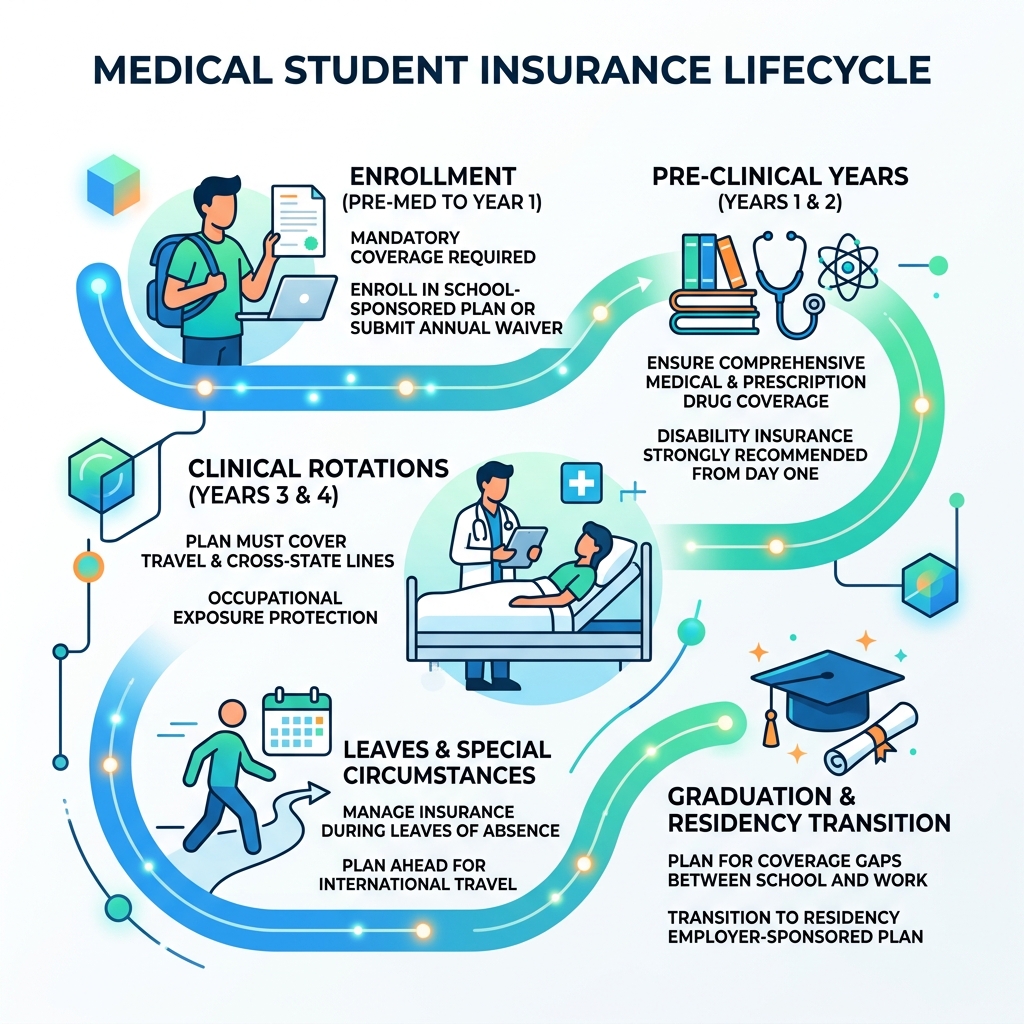
- Coverage is mandatory at most medical schools, required from day one of enrollment
- School-sponsored plans (through major national insurers) are the most common option
- Waivers are possible if you have comparable coverage, but must be resubmitted every year
- Mental health, pre-existing conditions, and prescription drugs (including hormonal contraception) should all be covered
- Disability insurance is often required separately, and is recommended from your first day of school
- International students have specific plan requirements, typically tied to F1 or J1 visa status
- Rotations, leaves of absence, and travel can all affect your coverage — and you need a plan that accounts for them
Medical school is already one of the most demanding journeys you can take. The last thing you need is a surprise medical bill or a coverage gap during a clinical rotation in another state.
The good news? Once you understand how medical student health insurance works, navigating it is much more manageable — even on a tight budget.
About 1 in 3 U.S. medical students receive insurance through a group program offered via their school. But there are still critical gaps many students don’t discover until it’s too late — like finding out their plan doesn’t follow them across state lines, or that disability insurance isn’t included in their health plan at all.
This guide breaks it all down in plain language.
Understanding Health Insurance for Medical Students
Navigating health insurance for medical students can feel like trying to memorize the entire Krebs cycle in one night. It’s dense, full of jargon, and feels high-stakes. However, understanding the basics is essential because, as a medical student, you aren’t just a student; you are a healthcare provider in training. This means your exposure to health risks-from hospital-acquired infections to the mental toll of clinical rotations-is higher than the average person.
Most medical schools require you to have active coverage as a condition of enrollment. If you don’t have a plan, the school will usually enroll you in their own sponsored plan and bill your student account. These plans are often negotiated as group rates to provide the best “benefits-to-premium” ratio.

When you look at a plan, you’ll see a network of providers. In-network providers have a contract with your insurance company to provide services at a pre-negotiated, lower rate. If you go out-of-network, you might find yourself footing a much larger portion of the bill. For example, if a physician charges $100 but the insurer’s “approved” rate is $70, staying in-network saves you that $30 difference immediately.
Before you choose, explore student health plan options to see how different networks compare.
Key Terms for Future Physicians
To talk the talk, you need to know the vocabulary of the insurance world:
- Premium: The “subscription fee” you pay every month (or semester) to keep your insurance active.
- Deductible: The amount you pay out of pocket for covered health care services before your insurance plan begins to pay.
- Copay: A fixed amount (e.g., $30) you pay for a covered health care service, usually when you receive the service (like a primary care visit).
- Coinsurance: Your share of the costs of a covered health care service, calculated as a percent (e.g., 20%) of the allowed amount for the service.
- Out-of-Pocket Maximum: The most you have to pay for covered services in a plan year. After you spend this amount on deductibles, copayments, and coinsurance, your health plan pays 100% of the costs of covered benefits.
- PPO vs. POS: A PPO (Preferred Provider Organization) usually offers more flexibility to see out-of-network providers (at a higher cost) without a referral. A POS (Point of Service) plan often requires you to get a referral from a primary care doctor before seeing a specialist.
Understanding these terms is especially important if you plan on doing rotations away from your home campus. You can find more info about using plans off-campus to ensure you aren’t hit with “out-of-network” surprises while you’re supposed to be focusing on your patients.
Navigating Health Insurance for Medical Students During Rotations
The third and fourth years of medical school often involve “away rotations.” This is where health insurance for medical students gets tricky. If your school-sponsored plan is tied to a local HMO network, you might find that you have zero coverage for non-emergency care once you cross state lines.
We recommend looking for plans with a broad or national provider network. These plans make it easier to find in-network doctors and urgent care centers across the country. Additionally, if you are struggling with the transition to clinical life, many student plans now include 24/7 virtual care and access to mental health support resources.
AAMC Recommendations and School Requirements
The Association of American Medical Colleges (AAMC) provides a set of guidelines to ensure that medical schools protect their students. According to AAMC recommendations, schools should require a 12-month policy that covers students during all school-sanctioned activities, including those in other states or countries.
Key AAMC-recommended coverages include:
- Mental Health and Psychiatric Care: Per LCME standards, schools must ensure students have access to confidential diagnostic, preventive, and therapeutic health services. This includes coverage for mental health crises.
- Pre-existing Conditions: Plans should not exclude you based on your medical history.
- Prescription Drugs: This must include coverage for hormonal contraception.
- Preventive Care: 100% coverage for immunizations and annual check-ups is standard.
If you or a peer are experiencing a crisis, the Suicide & Crisis Lifeline 988 provides free, confidential 24/7 support.
Clinical Safety and OSHA Compliance
In medical school, “workplace safety” means something very different. You are at risk for needlestick injuries and exposure to bloodborne pathogens. Your health insurance must comply with OSHA standards for infection control. This means the plan should cover the cost of prophylactic treatments and follow-up testing if an education-related injury occurs.
Furthermore, the AAMC suggests that schools require disability insurance from the very first day of enrollment. This ensures that if a student is injured during their training and can no longer continue their studies, they have some financial protection.
Comparing School-Sponsored Plans and Waivers
Many students wonder if they should stick with the school’s plan or find their own. School plans are often “best value” because they are negotiated for a younger, healthier population. However, if you are under 26, staying on a parent’s plan might be cheaper-provided that plan offers “adequate coverage” in the school’s location.
How to Waive School-Sponsored Insurance
If you have your own coverage (through a spouse or parent), you can usually waive the school’s insurance. However, this isn’t a “one and done” process.
- Annual Submission: You must submit a waiver application every single year.
- Comparable Coverage: Your private plan must meet the school’s specific criteria (e.g., specific deductible limits or local network access).
- Proof of Insurance: You’ll need to provide your policy number and sometimes a summary of benefits.
Be aware that schools are very strict about federal rules on sharing health data and will audit these waivers to ensure you aren’t left unprotected.
What is the Best Health Insurance for Medical Students?
The “best” plan depends on your family situation. Some schools, like NYU Grossman School of Medicine, actually subsidize 100% of the individual premium for their students. In most other cases, the school-sponsored plan offers the most comprehensive student-specific benefits, such as:
- Group Rates: Lower costs than individual marketplace plans for the same level of coverage.
- Dependent Coverage: Options to add a spouse or children (though this can be expensive-sometimes upwards of $20,000 a year for a full family).
- Broad Student Adoption: School-negotiated student plans remain a common choice because they are designed around the needs of medical training.
Essential Supplemental Coverage: Disability and Liability
While health insurance covers your doctor visits, it doesn’t protect your income or your career. That’s where supplemental insurance comes in.
Protecting Your Financial Future
Medical school is a massive financial investment. If a total disability prevents you from attending classes, who pays the bills?
- Student Disability Income Insurance: Group plans available through your medical school or professional associations can pay $1,000 a month for up to 12 months. The best part? These plans often offer guaranteed acceptance during open enrollment (July 1 – Dec 31) with no medical exam required.
- Term Life Insurance: For as little as $40 a year, you can get $100,000 in coverage. This is vital if you have private loans that would fall to your family in the event of your death.
- Portability: Look for plans that are “portable,” meaning they follow you from medical school into your residency.
Professional Liability and Malpractice
Most medical schools provide professional liability insurance for students, but only for “school-sanctioned activities.” This covers you if a patient claims you made a mistake during a clinical rotation.
However, if you are doing an independent medical brigade or a volunteer project not officially sponsored by your school, you might not be covered. Always check if you need “tail coverage” or additional risk management protection before stepping into an unofficial clinical role.
Specialized Options for International and Traveling Students
For international students on F1 or J1 visas, health insurance for medical students isn’t just a good idea—it’s often a legal requirement. Specialized international student health plans are designed specifically for this group, offering ACA-comparable coverage with low deductibles (as low as $40 in-network).
For more details, check out the ultimate guide to insurance for students studying overseas.
International Travel and Evacuation
If you are heading abroad for a medical rotation, your standard health insurance probably isn’t enough. You need Medical Evacuation and Repatriation coverage.
- Evacuation: Covers the cost (up to $100,000) to fly you to a high-quality hospital if you are injured in a remote area.
- Repatriation: Covers the cost of returning remains to your home country.
Many international-specific plans include these as standard features, but always double-check the policy limits.
Frequently Asked Questions about Health Insurance for Medical Students
Can I stay on my parents’ health insurance plan?
Yes, under the Affordable Care Act, you can generally stay on your parents’ plan until you turn 26. However, you must ensure the plan’s network includes doctors near your medical school. If your parents live in California and you go to school in New York, you might only have coverage for “emergency room” visits, which won’t satisfy your school’s waiver requirements.
What happens to my coverage during a leave of absence?
This varies by school. Some schools allow you to remain on the student health plan as long as you pay the premium, while others terminate coverage the moment your enrollment status changes. If you lose coverage, you may be eligible for COBRA or a Special Enrollment Period on the healthcare marketplace.
Does medical student insurance cover dental and vision?
Standard student health plans are only required to cover pediatric dental and vision (up to age 19). For adults, these are usually optional add-ons.
- Dental: Many schools offer a dental HMO plan for an additional annual fee (roughly $160–$200).
- Vision: You can often find discounted eyewear and exams through school-affiliated eye centers or separate vision plans.
Conclusion
At ACT Unis, we know that your focus should be on your patients and your exams, not on whether your insurance will cover a needlestick injury or a specialist visit. Health insurance for medical students is a cornerstone of your professional life—it protects your health, your finances, and your future career as a physician.
Don’t wait until the enrollment deadline to figure this out. Whether you are looking for a school-sponsored plan, a private waiver option, or supplemental disability coverage, being prepared is the best medicine.
Ready to secure your future? Start your student insurance journey here and let us help you find the peace of mind you need to succeed in medicine.