
A Student’s Guide to Health Insurance That Doesn’t Hurt
Why a Student Health Insurance Comparison Could Save You Thousands
Student health insurance comparison is something every college student — domestic or international — should do before picking a plan.
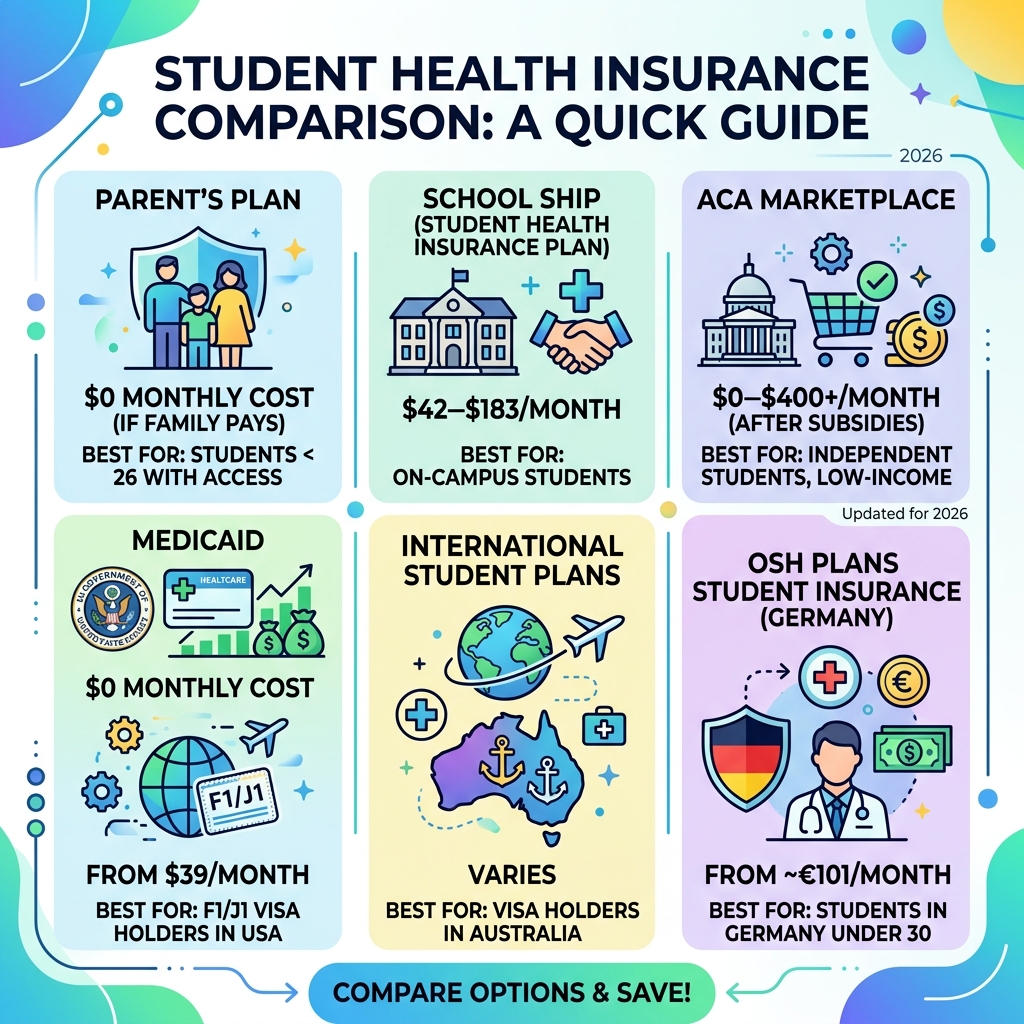
Here’s a quick breakdown of your main options:
| Plan Type | Best For | Typical Monthly Cost |
|---|---|---|
| Parent’s plan | Students under 26 with access to family coverage | $0 (if family pays) |
| School SHIP | On-campus students needing simple coverage | $42–$183/month |
| ACA Marketplace | Independent students, especially low-income | $0–$400/month after subsidies |
| Medicaid | Students below income threshold | $0 |
| International student plan | F1/J1 visa holders in the USA | From $39/month |
| Private student insurance (Germany) | Students in Germany under 30 | From ~$101/month |
| OSHC (Australia) | Student visa holders in Australia | Varies; save up to $300 by comparing |
About 1 in 7 college students has no health insurance at all. That’s a risky position — one accident or illness can mean thousands of dollars in bills with no safety net.
Young adults aged 19–25 already face some of the highest uninsured rates in the United States. And the problem isn’t just financial. Without coverage, many students skip doctor visits, delay mental health care, and avoid prescriptions they actually need.
The good news? There are more affordable options than most students realize. The challenge is knowing how to compare them.
A Comprehensive Student Health Insurance Comparison
When we look at the landscape of health coverage, it’s easy to feel like you’re studying for a final exam in a language you don’t speak. But at its core, a student health insurance comparison involves looking at four or five major “buckets” of coverage. For domestic students in the U.S., the most common starting point is the Student Health Insurance Plan (SHIP) offered directly by your university.
SHIPs are designed for convenience. They are often billed right alongside your tuition, and the doctors are usually right there on campus. However, just because it’s convenient doesn’t mean it’s the cheapest. Annual costs for SHIPs typically range from $500 to $2,200. Before you settle, you should check out Don’t Get Schooled by the 5-Star Student Policies to see if you’re getting the best deal.
Then there’s the ACA Marketplace. Thanks to the Affordable Care Act, plans on the marketplace must cover the 10 essential health benefits. This includes everything from emergency services and hospitalization to mental health care and prescription drugs. For many of us, especially those working part-time or with lower incomes, subsidies can bring these monthly premiums down significantly—sometimes even to $0.
Key Factors in a Student Health Insurance Comparison
If you’re diving into the Marketplace, you’ll encounter the “Metal Tiers.” This isn’t a ranking of your favorite bands; it’s a way to understand how you and the insurance company share costs:
- Bronze: Lowest monthly premium, but you pay about 40% of your care costs.
- Silver: Moderate premiums. If you qualify for “cost-sharing reductions,” these plans offer the best value for low-income students.
- Gold & Platinum: Higher monthly premiums, but the insurance company covers 80-90% of your medical bills.
One of the biggest “hacks” in any student health insurance comparison is the parent’s health insurance plan. Under current laws, you can stay on your parent’s plan until you turn 26. This is often the most affordable route, but there’s a catch: network flexibility. If your parents live in Florida and you’re going to school in New York, their plan might consider every doctor in New York “out-of-network,” leaving you with massive bills for routine visits.
Navigating Your Student Health Insurance Comparison
For those under 30, “Catastrophic plans” are another option. These have very low monthly premiums—averaging around $291/month—but very high deductibles. They are essentially a “break glass in case of emergency” policy. They won’t help much with a routine flu shot, but they’ll prevent you from going bankrupt if you have a major accident.
Short-term policies are the “quick fix” of the insurance world. They are great for filling a 30-day gap between graduation and a new job, but we generally advise caution. They often exclude pre-existing conditions and don’t cover those 10 essential benefits required by the ACA.
Finally, consider where you’ll actually be when you get sick. If you’re a traveler or a student who moves between home and campus frequently, you need to know How to Use Your Student Health Plan When You Wander Off Campus. Some plans have great on-campus access but leave you stranded once you cross the state line.

International Student Requirements and Global Plans
If you are an international student traveling to the U.S., Germany, or Australia, your student health insurance comparison isn’t just about saving money—it’s about staying legal. Most countries and universities have strict “waiver requirements.” This means you can’t just buy the cheapest plan you find online; it has to meet specific standards to satisfy your visa conditions.
For F1 and J1 visa holders in the U.S., the requirements are specific. J1 exchange visitors, for example, must have plans that provide at least $100,000 in medical benefits per accident or illness, $50,000 for medical evacuation, and $25,000 for repatriation of remains.
Specialized private providers have focused on this for decades. Some offer plans starting as low as $39/month for those on OPT (Optional Practical Training). These plans are often much cheaper than university-sponsored plans, but you must ensure your school will accept the “waiver” before you buy.
Mandatory Coverage in Germany and Australia
In Germany, the system is a bit different. You generally choose between statutory (public) insurance and private comprehensive insurance.
| Feature | Statutory (Public) | Private Comprehensive |
|---|---|---|
| Monthly Cost (Under 30) | ~145.52 EUR | ~101.54 EUR |
| Eligibility | Students under 30 | Students, interns, language pupils |
| Treatment | Standard public care | Private patient status (often faster) |
As you can see, choosing private insurance can save you about 90 EUR per month. However, once you choose private insurance, it can be very difficult to switch back to the public system later, so it’s a decision that requires a long-term view.
In Australia, the government mandates Overseas Student Health Cover (OSHC). It’s a non-negotiable visa condition (Condition 8501). If your OSHC lapses, your visa could be cancelled. The good news is that by using a comparison tool for OSHC providers, students save an average of $300 on their policy.
For a deeper dive into these requirements, check out The Ultimate Guide to Insurance for Students Studying Overseas.
Evaluating Costs and Essential Health Benefits
When we talk about the “cost” of insurance, most students only look at the monthly premium. That’s like only looking at the price of a car and forgetting about gas, insurance, and tires. A true student health insurance comparison looks at the “Total Cost of Care.”
- Monthly Premium: What you pay every month just to have the plan.
- Deductible: The amount you pay out of your own pocket before the insurance company starts chipping in. (For example, if you have a $1,500 deductible, you pay the first $1,500 of your medical bills).
- Co-payments (Co-pays): A flat fee you pay for a specific service (e.g., $20 for a doctor visit).
- Out-of-Pocket Maximum (MOOP): The absolute most you will have to pay in a year. Once you hit this number, the insurance company pays 100% of everything else.
Preventive care—like your annual check-up, flu shots, and many screenings—is usually covered at 100% with no co-pay or deductible required, as long as you stay in-network. This is a huge benefit that many students leave on the table!
Coverage for Mental Health and Specialized Services
College is stressful. Between exams, social pressures, and being away from home, mental health support is often the most used part of a student’s insurance plan. Under the ACA, mental health and substance abuse services are essential health benefits. This means your plan must cover counseling and inpatient mental health treatment just like it would a broken arm.
Telehealth has also become a game-changer for students. Many top-rated plans now offer 24/7 access to doctors and therapists via your smartphone. This is perfect for those 2:00 AM “do I have the flu or just a bad cold?” moments in the dorm.
Specialized services like maternity care and pre-existing conditions are also protected. Gone are the days when an insurance company could refuse to cover you because you had asthma or diabetes before you signed up.
Frequently Asked Questions about Student Insurance
Can I stay on my parent’s plan if I study in a different state?
Yes, you can stay on your parent’s plan until age 26, regardless of where you live. However, you must check the “Provider Network.” If the plan is an HMO and only has doctors in your home state, you might only be covered for “Emergency Room” visits while at school. For routine care, you might be stuck paying full price.
What are the minimum insurance requirements for a US student visa?
For J1 visa holders, the U.S. Department of State requires:
- Medical benefits of at least $100,000 per accident or illness.
- Repatriation of remains in the amount of $25,000.
- Medical evacuation coverage of $50,000.
- A deductible not to exceed $500 per accident or illness. F1 visa requirements are usually set by the individual university rather than the federal government, but they often mirror these standards.
How do I waive my university’s automatic health insurance enrollment?
Most universities “auto-enroll” you in their SHIP and add the charge to your tuition bill. To waive this, you must provide proof that you have “comparable coverage.” You’ll usually need to submit your policy’s summary of benefits to the school’s insurance portal before the semester deadline. If approved, the charge is removed from your account.
Conclusion
Navigating a student health insurance comparison doesn’t have to be a headache. Whether you’re staying on a parent’s plan, opting for a university SHIP, or finding a specialized international policy, the key is to act before the deadline.
The “best” insurance isn’t always the cheapest one—it’s the one that covers the doctors near your campus and protects you from massive medical debt. Keep an eye on enrollment deadlines (usually around the start of the semester) and always keep a digital copy of your insurance card on your phone.
At ACT Unis, we want to make sure you’re protected so you can focus on what really matters: passing that organic chemistry final. Explore more student resources to stay ahead of the curve!
Final Checklist Before Enrolling:
- [ ] Does this plan meet my university’s waiver requirements?
- [ ] Are there in-network doctors within 5 miles of my campus?
- [ ] Does the plan cover mental health and prescriptions?
- [ ] Can I afford the deductible if I have an emergency?
- [ ] Have I compared the total annual cost (Premiums + Deductible)?