Student Car Insurance That Costs Less Than Your Textbooks
Why College Students Pay Too Much for Car Insurance (And How to Fix It)
Affordable student car insurance is easier to find than most students think — if you know where to look.
Here are the best ways students can lower their car insurance costs right now:
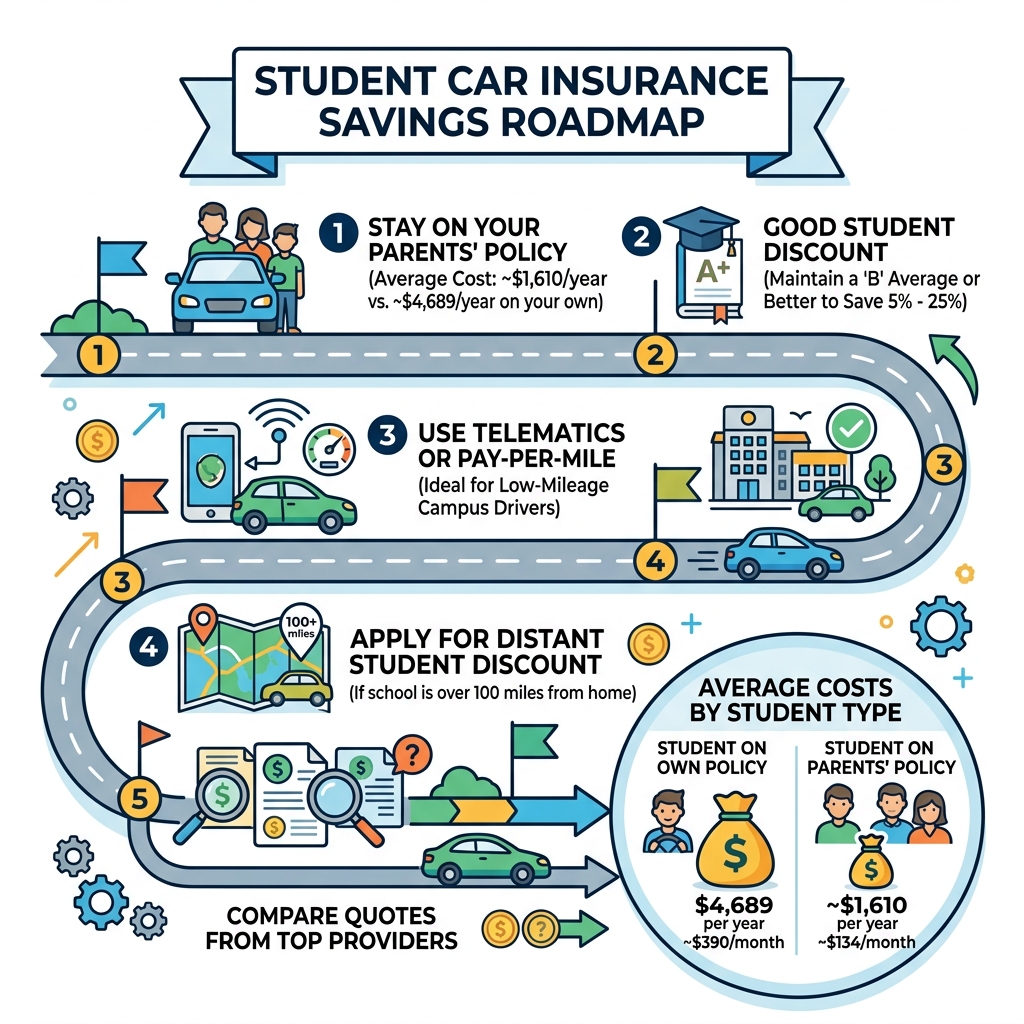
- Stay on your parents’ policy — average cost: ~$1,610/year vs. $4,689/year on your own
- Get a good student discount — a B average or better can save you 5% to 25%
- Use a telematics or pay-per-mile program — ideal for low-mileage campus drivers
- Apply for a distant student discount — if your school is 100+ miles from home
- Compare quotes from top providers — GEICO and USAA consistently offer the lowest rates for students
Being a student is already expensive. Tuition, rent, groceries — and then car insurance lands on top of all of it.
Here’s the hard truth: drivers between 16 and 25 pay more for car insurance than any other age group. Insurers see young drivers as higher risk, and your premiums reflect that.
College students on their own policies pay an average of $4,689 per year. That’s nearly $400 a month — more than many students spend on groceries.
But there’s real room to save. The right insurer, the right discounts, and the right policy structure can cut that number significantly. This guide breaks down exactly which companies offer the best quotes, which discounts you actually qualify for, and when it makes sense to stay on your parents’ plan versus going it alone.
Understanding the Cost of Affordable Student Car Insurance
When we talk about affordable student car insurance, it is important to understand the baseline. On average, college students pay between $250 and $450 per month for their own car insurance policies. If that sounds like a lot, it’s because it is. Statistically, young drivers are involved in more accidents and file more claims than any other demographic.

Several factors influence these high rates:
- Age and Inexperience: Drivers under 25 lack the years of “clean” driving history that insurers use to justify lower rates.
- Location: If you move from a rural hometown to a densely populated college town, your rates will likely climb due to the increased risk of theft and fender benders in campus parking lots.
- Driving Record: Even a single speeding ticket or a minor “parking lot tap” can send premiums skyrocketing for a student.
To give you a clearer picture of what to expect, we’ve broken down the average annual costs based on academic level:
| Student Type | Average Monthly Cost | Average Annual Cost |
|---|---|---|
| High School Student (16-18) | $317 – $336 | $3,800 – $4,032 |
| College Student (18-21) | $250 – $450 | $3,000 – $5,400 |
| Graduate Student (22-29) | $180 – $192 | $2,160 – $2,304 |
As you can see, rates tend to drop as you gain more experience and move into graduate studies. However, the most significant price difference comes from how you are insured. Adding an 18-to-21-year-old to a parents’ policy costs an average of $1,610 annually, whereas that same student getting their own policy would pay an average of $4,689.
Strategic Ways to Lower Your Premiums
Finding affordable student car insurance isn’t just about picking the right company; it’s about stacking every possible discount available to you. We recommend starting with the “Big Three”: a clean record, professional training, and smart bundling.
- The Good Driver Reward: Most insurers offer a significant discount if you have no accidents or violations for five years. For a 21-year-old, this means staying ticket-free since you got your permit!
- Driver Training Courses: Completing an approved defensive driving or “Pass Plus” course can lower your perceived risk. These courses prove to the insurer that you are taking safety seriously.
- Bundling with Renters Insurance: If you live off-campus, you likely need renters insurance to protect your laptop and furniture. Many companies offer a discount if you bundle your auto and renters policies together.
Qualifying for an Affordable Student Car Insurance Discount
The most famous way to save is the “Good Student Discount.” Insurers have found a statistical correlation between high GPAs and responsible driving.
- The Requirement: Usually, you must be a full-time student under age 23 or 25 (depending on the provider) and maintain a B average (3.0 GPA) or better.
- The Savings: This discount is incredibly impactful, ranging from 5% at Progressive to as much as 25% at State Farm.
- Proof of Performance: You’ll need to provide a recent transcript, a report card, or a form signed by a school administrator. For homeschooled students, scoring in the top 20% of national standardized tests like the SAT or ACT often qualifies you for the same savings.
When to Purchase Independent Affordable Student Car Insurance
While staying on a parent’s policy is cheaper, there are times when we must advise students to strike out on their own. You typically need a separate policy if:
- The Title is in Your Name: If the car’s title is solely in the student’s name, most insurers require an independent policy.
- Permanent Residency Change: If you have moved out permanently and no longer use your parents’ address as your primary residence, you need your own coverage.
- International Students: If you are an international student, you will need a U.S.-based policy. Companies like Marshmallow often use technology to provide fairer pricing for those without a long U.S. driving history.
Policy Ownership and Out-of-State Rules
For most students, the best path to affordable student car insurance is remaining a “named driver” on their parents’ policy. This allows you to benefit from their established insurance score and multi-car discounts.
- Primary Residence: As long as you return home during breaks and your parents’ house is considered your “permanent” address, you can usually stay on their policy.
- Out-of-State Students: If you take your car to a school in a different state, you must notify your insurer. While you can often stay on the family policy, the premium might be adjusted based on the school’s ZIP code. Some states have specific rules about where a vehicle must be registered if it stays there for more than 90 days.
- Age Limits: Good news—there is generally no “cutoff age” for staying on a parent’s policy, provided you still share a permanent residence and don’t own the vehicle yourself.
Usage-Based and Specialized Coverage Options
If you only use your car for grocery runs or the occasional trip home, you shouldn’t be paying the same rate as a long-distance commuter.
- Distant Student Discount: This is a hidden gem. If you leave your car at your parents’ house and your school is more than 100 miles away, your parents can get a massive discount because you aren’t driving the vehicle daily.
- Telematics and “Black Box” Programs: Programs like Snapshot or State Farm’s Steer Clear track your driving habits via an app. If you avoid hard braking and late-night driving, you can see significant rate reductions.
- Pay-Per-Mile: For students who drive less than 5,000 miles a year, pay-per-mile options like Allstate’s Milewise can be much more affordable.
- Storage Coverage: If you’re heading to a city where you won’t need a car at all, consider “storage” or “comprehensive-only” coverage. This keeps the car protected against theft or fire while it’s parked, without the high cost of liability and collision insurance.
Frequently Asked Questions about Affordable Student Car Insurance
Can college students stay on their parents’ car insurance while at school?
Yes, in most cases. As long as the student is a full-time student and maintains the parents’ home as their permanent legal residence, they can stay on the policy. This is usually the most cost-effective option, saving families thousands of dollars compared to separate policies.
What proof of academic performance is required for student discounts?
Insurers typically require a certified transcript or a report card from the most recent semester. Some companies, like Nationwide, also accept a letter from the school registrar confirming the student’s “Good Standing” or placement on the Dean’s List.
Should students consider storage options when leaving their car at home?
If the car will not be driven at all for several months, switching to storage coverage is a smart financial move. It maintains a “continuous insurance” history (which prevents future rate hikes) while dropping the expensive liability and collision portions of the premium. Just remember: you cannot drive the car at all while it is under storage coverage.
Conclusion
Securing affordable student car insurance is a balancing act between maintaining good grades, choosing the right policy structure, and shopping around. Whether you are staying on a family plan or looking for your first independent policy, your status as a student opens doors to discounts that disappear once you graduate.
Don’t settle for the first quote you see. By leveraging good student discounts, telematics, and distant student perks, you can keep your car on the road without draining your savings.
Ready to see how much you could save? Get a quote for affordable student car insurance today and put those extra dollars back into your graduation fund (or more textbooks).