
Don’t Get Schooled by the 5-Star Student Policies
What You Need to Know About 5-Star Student Policies Before You Enroll
5-star student policies cover two distinct but connected areas every student should understand: the data privacy and engagement rules of the 5-Star Students platform used by schools, and the academic achievement policies that unlock scholarships and university admission guarantees.
Here is a quick overview of both:
5-Star Students Platform Policies
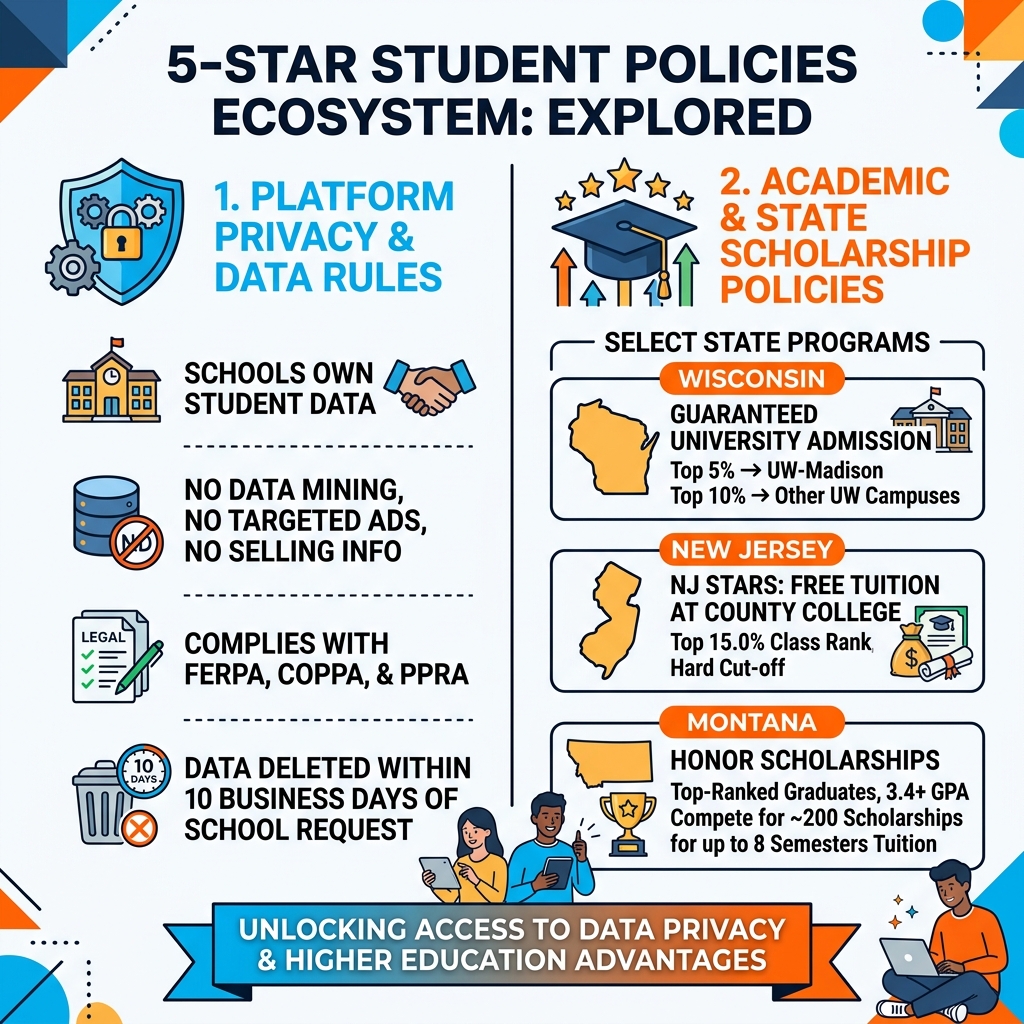
- Schools own all student data; the platform only processes it on their behalf
- No data mining, no targeted advertising, no selling student information
- Complies with FERPA, COPPA, and PPRA
- Student data deleted within 10 business days of a school’s written request
Academic “5-Star” Student Policies by State
- Wisconsin: Top 5% of class gets guaranteed UW-Madison admission; top 10% gets guaranteed entry to all other UW campuses
- New Jersey: Top 15.0% (hard cut-off, no rounding) earns free tuition at home county college via NJ STARS
- Montana: Top-ranked graduates with a 3.4+ GPA compete for roughly 200 Honor Scholarships covering up to 8 semesters of tuition
These policies directly affect your access to free or reduced-cost higher education — and your rights over your own data while you are still in school.
Whether your school uses the 5-Star Students engagement platform or you are chasing a class-rank-based scholarship, knowing the rules gives you a real advantage.
Understanding the 5-Star Students Platform and Privacy Framework
In the modern classroom, “5-star” isn’t just a rating for a good movie; it’s often the name of the software managing how you interact with your school. 5-Star Students is a comprehensive engagement platform designed to track co-curricular involvement, manage event attendance, and boost school spirit. However, with great data comes great responsibility.

When we look at 5 star student policies, the first thing to understand is the privacy framework. Because the platform handles sensitive information—like who you are, what clubs you join, and when you show up to the big game—it must adhere to strict legal standards. You can even track real-time Privacy Policy updates to see exactly how these rules evolve.
Service Overview and Data Collection
How does the system actually know you’re there? The platform uses a mix of high-tech tools to gather involvement data. This includes barcode scanning at event entrances, mobile apps for student check-ins, and digital portals for surveys and voting.
Schools typically provide the platform with basic student credentials to get started. From there, the system collects “technology-collected usage data,” which helps administrators see which students are active and which might be feeling left out. It’s not just about tracking; it’s about making sure every student has a chance to shine.
Privacy Standards and Third-Party Restrictions
We know what you’re thinking: “Is my data being sold to advertisers?” The short answer is a resounding no. One of the most critical 5 star student policies is the ban on data mining. 5-Star Students does not use student information for targeted advertising, nor do they sell aggregated data to third parties for marketing.
All data is stored on secure servers located exclusively within the United States. Access is limited to necessary service providers who help the platform run, and law enforcement disclosure only happens if it is legally mandated. Essentially, the school remains the “owner” of the data, and the platform acts as a high-security vault.
Key Features of 5-Star Student Policies for Engagement
Engagement is the heartbeat of a successful school. When students feel connected, they perform better. 5-Star Students uses a “gamified” approach to encourage this connection, turning school participation into a rewarding experience.
Incentives and Recognition within 5-Star Student Policies
The core of the engagement strategy involves participation points. Schools can assign point values to different activities—attending a theater performance might be worth 10 points, while joining the math club earns 20.
Administrators use these policies to:
- Identify involvement gaps: Seeing which students aren’t participating in any activities.
- Manage incentives: Offering rewards like spirit gear or event discounts for reaching point milestones.
- Monitor progress: Publishing results online so students can see their standing and feel a sense of achievement.
Supporting Student Basic Needs and Success
While points and badges are fun, the underlying goal of these 5 star student policies is to improve retention and persistence. Research shows that students who are engaged in their school community are less likely to drop out.
However, engagement is difficult when basic needs aren’t met. According to The Hope Center’s 2025 Federal Policy Priorities, nearly 3-in-5 students experience some form of basic needs insecurity. By using engagement data, schools can better identify students who may need holistic support or emergency aid, ensuring that a lack of resources doesn’t stand in the way of a “5-star” education.
Aligning Conduct and Discipline with 5-Star Student Policies
A “5-star” school isn’t just about fun and games; it’s about maintaining a safe and productive environment. Many districts, such as Adams 12 Five Star Schools, have established rigorous conduct expectations that integrate with their digital systems.
Conduct Expectations and Sanctions
Policy 5000 is the gold standard for many “Five Star” districts when it comes to student behavior. It defines the grounds for sanctions to ensure the learning environment remains free from disruption. Key areas of focus include:
- Safety Violations: Firearms possession carries a mandatory recommendation for expulsion across all grade levels.
- Substance Abuse: Strict bans on drugs and controlled substances on school grounds and buses.
- Bullying and Harassment: Policies designed to protect the mental health and safety of every student.
- Off-Campus Behavior: For students in grade 3 and higher, certain off-campus behaviors can still result in school sanctions if they impact the school community.
Integration with School Handbooks
These conduct policies aren’t secrets. Schools are required to notify students and parents of their rights and responsibilities through official handbooks. This ensures due process—the idea that if you are accused of a violation, you have a right to be heard and the right to a fair administrative review by a designated principal or district official.
Data Security and Compliance Standards
Security is the backbone of any edtech platform. Unlike some “free” apps that pay for their services by selling your habits, 5 star student policies are built on compliance with federal law.
| Feature | 5-Star Students Practice | Typical Edtech “Data Mining” |
|---|---|---|
| Data Ownership | School/District | Often claimed by the provider |
| Targeted Ads | Strictly Prohibited | Common revenue source |
| FERPA/COPPA | Full Compliance | Sometimes “grey area” |
| Data Deletion | Within 10 days of request | May keep data indefinitely |
Security Measures and Breach Notification
To keep your information safe, 5-Star Students implements several layers of protection:
- SSL Encryption: Protecting data as it moves from your phone or computer to the server.
- Firewalls: Blocking unauthorized access to the central database.
- Password Credentials: Ensuring only authorized staff and students can log in.
In the unlikely event of a security breach, 5 star student policies require the platform to notify the affected schools promptly so that parents and students can be informed.
Data Deletion and Control under 5-Star Student Policies
One of the most powerful rights a school has is the “right to be forgotten.” If a school decides to stop using the service, they can submit a written request for data deletion. The platform is contractually obligated to comply within 10 business days. Furthermore, upon account termination, data is typically de-identified or deleted within 72 hours, with backups purged within 60 days.
Leveraging 5-Star Student Policies for Scholarships and Awards
If you are a high achiever, the term “5-star student” likely refers to your class rank and GPA. Many states have specific 5 star student policies that reward the top tier of graduates with massive financial incentives.
State-Specific Scholarship Alignment
Several states use “Top %” rules to determine who gets the best financial aid packages:
- Wisconsin: Under the Wisconsin Academic Excellence Scholarship guidelines, the highest-ranking seniors are designated as scholars. Additionally, the “Wisconsin Guarantee” ensures that students in the top 5% of their class (at schools with 15+ students) are guaranteed admission to UW-Madison.
- New Jersey: The NJ STARS program offers free tuition at county colleges for those in the top 15.0% of their class. Note the “no rounding” rule—a 15.1% rank won’t cut it!
- Montana: The MUS Honor Scholarship targets 200 annual awards for students with a minimum 3.4 GPA and high ACT/SAT scores.
Tie-Breakers and Selection Criteria
What happens if two students have the exact same GPA? This is where the fine print of 5 star student policies becomes crucial. Common tie-breakers include:
- ACT/SAT Scores: The student with the higher composite score often takes the lead.
- Core Subject GPA: Looking specifically at math, science, English, and social studies.
- Advanced Coursework: Counting the number of AP, IB, or Dual Enrollment credits.
- The “Coin Flip”: In some districts, if every other metric is identical, a literal random draw or coin flip determines the scholarship recipient.
Frequently Asked Questions about 5-Star Student Policies
How does 5-Star Students comply with FERPA and COPPA?
5-Star Students acts as an “outsourced institutional function” under FERPA, meaning they handle data as an extension of the school itself. For students under 13, the platform complies with COPPA by requiring schools to obtain verifiable parental consent before any personal information is collected.
Can schools delete student data upon account termination?
Yes. Upon termination, 5-Star Students is required to delete or de-identify student data within 72 hours. While some anonymized data may be kept for internal service improvements, all personally identifiable information (PII) is removed from active servers and eventually from backups.
How do 5-Star Student policies support state-funded scholarships?
By providing accurate tracking of student involvement and achievements, platforms like 5-Star Students help schools generate the reports needed to certify class rank and eligibility for state programs like NJ STARS or the Wisconsin Academic Excellence Scholarship.
Conclusion
Navigating 5 star student policies might seem like a full-time job, but the effort pays off. Whether it’s ensuring your data is handled with the respect it deserves on an engagement platform or maintaining the GPA needed to unlock a debt-free college education, these policies are the roadmap to your future success.
At ACT Unis, we believe that informed students are empowered students. By understanding the rules of engagement and the standards of excellence, you can make the most of your high school years and set yourself up for a brilliant transition to higher education.